
Hoary mustard
Hirschfeldia incana
Description
How to tell it apart
Hoary mustard (Hirschfeldia incana) belongs to the Brassicaceae family. It is an annual or biennial herbaceous plant that typically grows from 30 to 80 cm, sometimes taller.
The stem is erect, branched in the upper part, and covered with coarse hairs that give it a grayish appearance. Basal leaves are arranged in a rosette and are lyrate-pinnatifid, while stem leaves are lanceolate or linear.
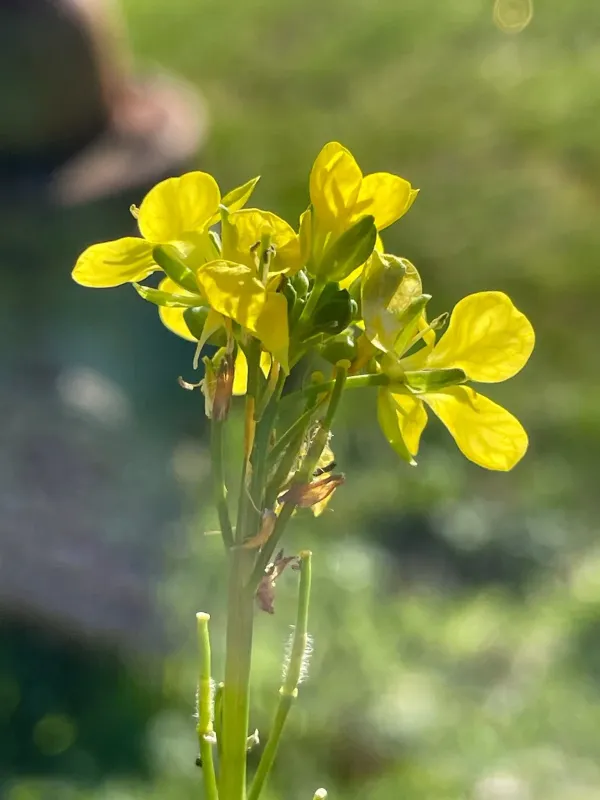
The flowers are small, light yellow, and arranged in loose racemes at the tops of the stems. Flowering is prolonged, which contributes to the rapid accumulation of a seed bank in the soil.
The fruits are short pods that are pressed tightly against the raceme axis or pointing upwards. The seeds are small, round, and brown, possessing high viability in the soil.
Biologically, the plant is a typical ruderal species that easily adapts to various soil types, including dry and saline areas.
Where it grows
This weed is widespread in temperate and subtropical climates. It is often found along roadsides, on abandoned land, wasteland, and uncultivated fields, rapidly occupying available areas.
In agro-ecosystems, Hoary mustard is particularly dangerous in cereal, pulse, and technical crop fields. It actively infests perennial grasses, where it can dominate due to the lack of deep tillage.
The plant prefers well-lit areas with light or medium-textured soils. It exhibits high drought tolerance, which allows it to compete with crops even during hot periods.
Seeds are dispersed by wind, water, and agricultural machinery during harvest and soil tillage operations. High seed production capacity contributes to rapid spread to new territories.
Under intensive farming conditions, this weed is often found in mixed stands with other Brassicaceae species, complicating selective control measures.
Harm it causes
The harm caused by Hoary mustard consists of powerful competition for nutrients, moisture, and light. It can significantly reduce crop yields during the early stages of development.
The weed acts as a reservoir for dangerous crop diseases and pests. Flea beetles, aphids, and fungal pathogens often develop on it before migrating to cultivated plants.
In winter crops, Hoary mustard overwinter in the rosette phase, giving it a growth advantage in early spring. This leads to the suppression of young crop shoots immediately after snowmelt.
Harvesting difficulty increases due to the weed's presence: stems can clog combine harvesters, and the mixture of mustard seeds degrades the quality of marketable grain, requiring additional cleaning costs.
Long-term infestation of fields with this species leads to gradual soil depletion and reduced overall crop rotation productivity due to allelopathic effects on soil microbiota.
How to control
Agrotechnical measures include strict adherence to crop rotation incorporating row crops, which allow for inter-row cultivation during the weed's growing season.
Deep primary tillage (plowing) is an effective practice that promotes deep burial of seeds, preventing them from germinating. Thorough control of seed purity is also essential to prevent the introduction of seeds into fields.
Chemical control is performed using systemic herbicides. In cereal crops, products based on 2,4-D, dicamba, or sulfonylureas are used to effectively target broadleaf weeds.
- Timely stubble cultivation immediately after harvest.
- Application of herbicides in the early development phases (cotyledon to 2-4 true leaf stage).
- Control of road verges and boundaries to eliminate secondary infection sources.
- Use of tank mixes to prevent the development of weed resistance.
To prevent re-infestation, fields should be monitored during the post-harvest period, and if necessary, glyphosate-based herbicides should be used on fallow or idle land.
Taxonomy
- Latin name
- Hirschfeldia incana
- Family
- Крестоцветные
- EPPO code
- HISIN