
Erysimum virgatum
Erysimum virgatum
Description
How to tell it apart
Erysimum virgatum belongs to the Brassicaceae family. It is a biennial or perennial herbaceous plant with an upright stem, typically reaching a height of 30 to 80 centimeters.
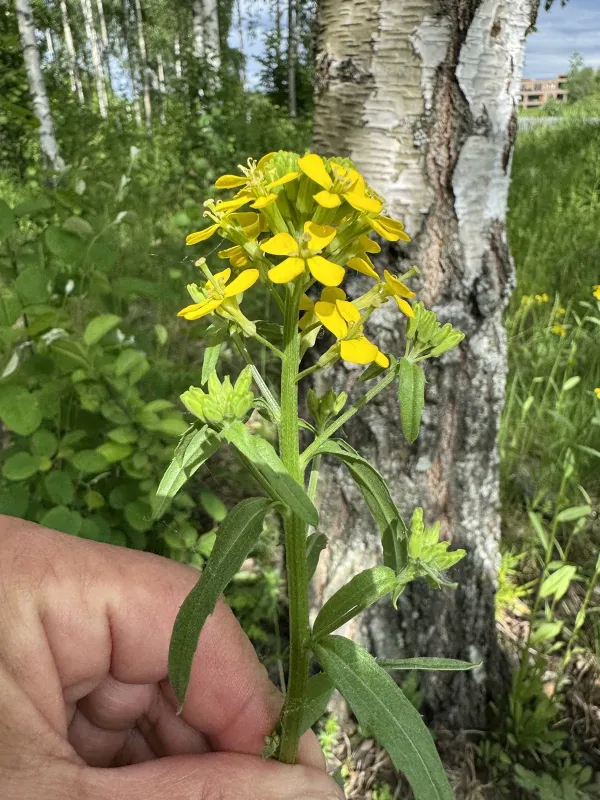
The leaves are lanceolate to linear-lanceolate, usually entire or slightly toothed, and covered with appressed hairs that give the foliage a characteristic grayish-green appearance.
Small, bright yellow flowers are grouped in terminal racemes. This coloration makes the plant easily recognizable during the flowering period, which usually occurs from late spring through summer.
The fruit is a slender, elongated pod containing numerous small seeds. Once ripe, these pods split open, facilitating the dispersal of seeds by wind or agricultural machinery.
The plant features a strong taproot, which allows it to thrive in nutrient-poor or compacted soils where other, more sensitive plant species might struggle to establish.
Where it grows
This weed is commonly found in open spaces, including steppes, hillsides, roadsides, and abandoned pastures. It prefers well-drained, dry, and sandy or loamy substrates.
In agricultural settings, Erysimum virgatum frequently colonizes cereal crops, perennial grasslands, and fallow lands. It is a classic ruderal species that quickly exploits disturbed soil.
Its presence is often a sign of insufficient weed management in field margins or improper soil cultivation techniques that fail to suppress early-stage growth.
The species is well-adapted to temperate climates and can quickly dominate areas where the canopy of the main crop is thin or damaged by drought or pests.
It is often seen spreading along the borders of fields, where it acts as a constant source for re-infestation of the inner agricultural area during harvest and cultivation.
Harm it causes
The primary damage caused by Erysimum virgatum is competition for water and soil nutrients, which can significantly reduce crop yields in stressed or dry conditions.
The weed acts as an allelopathic agent, secreting substances into the soil that can inhibit the germination and early development of neighboring crop seedlings.
Presence of the weed in seed crops is highly detrimental, as its seeds are difficult to separate from those of valuable crops, leading to lower commodity market grades.
The plant serves as a host for various pests and diseases that affect other Brassicaceae, potentially increasing the overall pathogen load in the field throughout the season.
High infestation rates increase production costs due to the need for extra mechanical cleaning or chemical applications to maintain acceptable quality standards.
How to control
Effective management requires a combination of deep primary tillage to bury seeds and shallow mechanical cultivation to destroy emerging seedlings during the pre-seeding period.
Implementing a diversified crop rotation is crucial, as it disrupts the life cycle of the weed and allows for the application of various herbicide programs with different modes of action.
Post-emergence chemical control using selective herbicides targeting broadleaf weeds in the Brassicaceae family is recommended during the early development stages.
Sanitation of field borders and non-crop areas is necessary to prevent the wind-dispersal of seeds into the cultivated sections of the field.
- Use high-quality, certified seed to avoid introduction of weed seeds.
- Clean harvesting equipment thoroughly before moving between different fields to prevent seed transfer.
Taxonomy
- Latin name
- Erysimum virgatum
- Family
- Крестоцветные
- EPPO code
- ERYHI