
Hairy bittercress
Cardamine hirsuta
Description
How to tell it apart
Hairy bittercress (Cardamine hirsuta) is a member of the Brassicaceae family. It is a small annual or biennial herbaceous plant known for its rapid life cycle, often completing its development from seed to seed in just a few weeks.
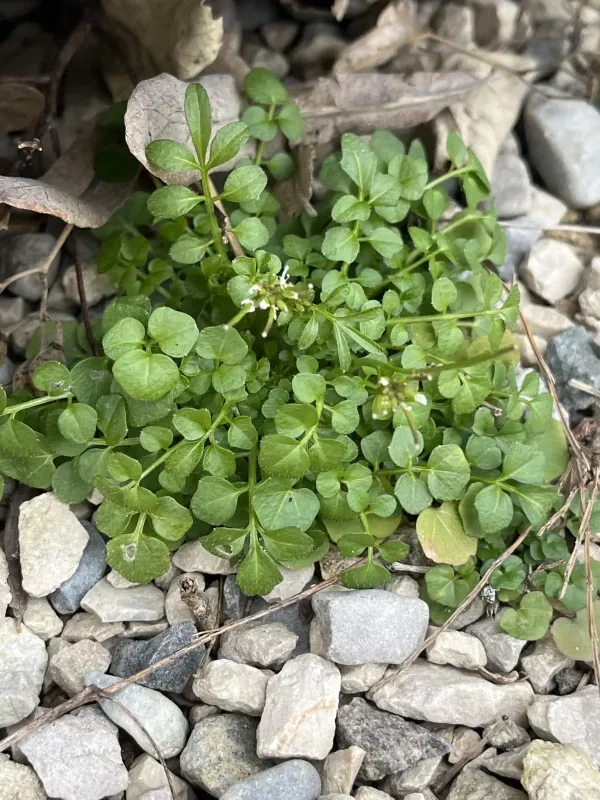
The plant grows as a basal rosette of pinnate leaves, from which several upright, thin flowering stems emerge, reaching heights of 5 to 30 cm. Small white flowers with four petals are arranged in terminal clusters.
The most distinctive feature is its seed pods, known as siliques. When mature, these pods are highly sensitive to touch and explode, ejecting seeds up to several meters away, which contributes to rapid and widespread infestation.
The root system is a shallow taproot, allowing the plant to thrive in compact soil, small cracks in concrete, or even the top layer of potting mix in greenhouse containers.
Due to its high plasticity, the plant can vary significantly in size, making it easily overlooked when young, yet it remains a persistent colonizer of disturbed soils.
Where it grows
This weed is found globally in a variety of habitats, including gardens, cultivated fields, and especially in nurseries and greenhouse operations where moisture and nutrients are abundant.
In agricultural systems, hairy bittercress is a significant problem in winter crops. It exploits the open space between young crop plants during the early spring before the crop canopy closes.
It is a common contaminant in plant nurseries, where it arrives in commercial potting mixes and quickly establishes itself in nursery pots, competing with the growth of ornamental species.
The weed prefers moist, nutrient-rich soils and often thrives in areas with consistent irrigation, making it a frequent nuisance near irrigation pipes and misting systems in greenhouses.
Its ability to germinate throughout most of the year, provided there is enough moisture, ensures a constant presence in the soil seed bank of affected areas.
Harm it causes
The primary harm caused by hairy bittercress is its role as a competitive weed for water and nutrients, which can stunt the development of sensitive young crops during critical growth stages.
It serves as an alternative host for various pests and pathogens, including those that affect important brassica crops, such as cabbage, rapeseed, and mustard, thereby facilitating disease outbreaks.
In greenhouse and nursery environments, mass colonization by this weed can create high humidity at the soil surface, promoting the development of fungal infections and mold that threaten plant health.
Presence of the weed in ornamental containers or crop trays significantly reduces the market value of the goods, necessitating expensive manual labor for weeding and cleaning.
Massive infestations can interfere with agricultural machinery operations during harvest and can complicate the classification of harvested products due to seed contamination.
How to control
The most effective agrotechnical method is the removal of the plant before it sets seed. Regular mechanical cultivation and hoeing of inter-rows can easily kill the young plants before they reach the flowering stage.
In greenhouses, using mulching techniques or placing coarse gravel over the soil can create a physical barrier that prevents hairy bittercress seeds from germinating and establishing roots in the soil.
Chemical control involves the use of selective herbicides, though care must be taken to choose products that do not injure the primary crop, especially given the similarity between some crops and this weed.
Managing soil moisture and ensuring proper drainage can reduce the attractiveness of the environment to this weed, as it thrives primarily in consistently damp, undisturbed soil.
For non-crop areas, glyphosate-based herbicides are effective, but consistent monitoring and follow-up treatments are required due to the weed's explosive seed dispersal mechanism and continuous germination cycles.
Taxonomy
- Latin name
- Cardamine hirsuta
- Family
- Крестоцветные
- EPPO code
- CARHI