
Eelgrass
Zostera marina
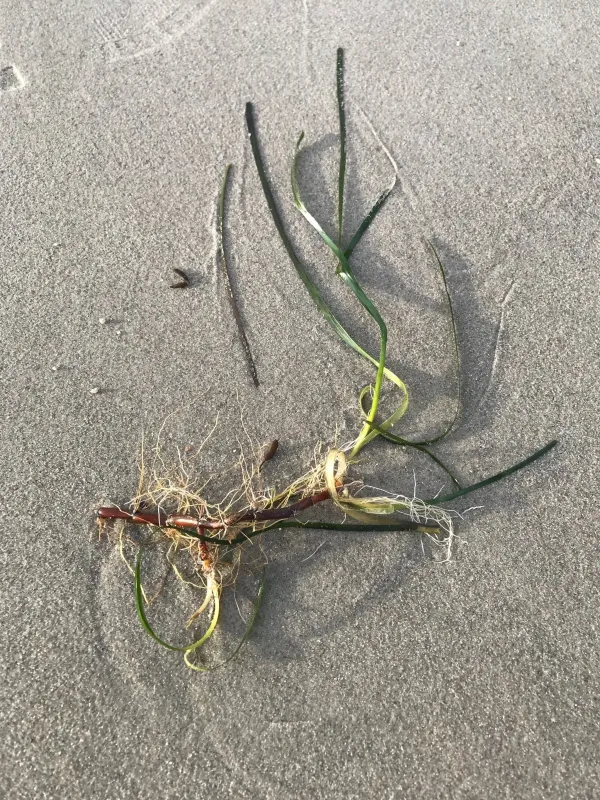
Description
How to tell it apart
Eelgrass (Zostera marina) is a perennial marine flowering plant belonging to the Zosteraceae family, characterized by long, creeping rhizomes buried in the seafloor.
The leaves are ribbon-like, bright green, reaching up to one meter in length and 9 millimeters in width, with distinct parallel venation patterns.
The flowers are tiny and inconspicuous, arranged in spikes hidden within the leaf sheaths, facilitating both sexual and vegetative reproduction.
Biologically, it is a true marine hydrophyte adapted to saline conditions, forming dense underwater meadows that serve as vital habitats but also act as invasive weeds in infrastructure.
Although often confused with seaweed, Zostera marina is a vascular plant, distinct from algae due to its complex structure involving roots, stems, and seeds.
Where it grows
Zostera marina thrives in shallow coastal waters, estuaries, and protected bays where current velocity is low, allowing it to take root in sandy or silty substrates.
It occupies intertidal and subtidal zones, surviving exposure to air during low tide provided the surrounding substrate remains sufficiently moist.
In agricultural settings, eelgrass can colonize water intake channels and irrigation systems that draw water directly from marine or brackish environments.
The global distribution spans temperate zones of the Northern Hemisphere, where it creates vast beds that can interfere with coastal maritime and irrigation operations.
Its ability to propagate via rhizomes makes it a highly resilient species, capable of quickly recolonizing cleared areas if environmental conditions remain favorable.
Harm it causes
The primary economic impact involves the clogging of water intake systems, drainage pipes, and port facilities, which disrupts the maintenance of coastal agricultural infrastructure.
Dense beds of eelgrass significantly reduce water flow, leading to increased sedimentation and silting, which necessitates frequent and costly mechanical dredging.
Mass decomposition of eelgrass biomass in stagnant water can lead to localized hypoxia and eutrophication, negatively affecting the surrounding aquatic environment.
Eelgrass acts as a competitive weed in mariculture facilities, where it can overtake space and nutrients required for target aquatic crops.
Physical interference with pumps and irrigation machinery increases operational costs and leads to equipment downtime caused by vegetative debris clogging intake valves.
How to control
Mechanical control, such as dredging or using specialized underwater mowers, is the most common method for removing eelgrass from critical water passages.
Altering the hydrological profile, such as deepening channels to exceed the light compensation point, effectively prevents further colonization by the plant.
In smaller, closed-loop water systems, shading the surface to block sunlight is an effective strategy to suppress photosynthesis and kill existing eelgrass colonies.
Chemical control is generally discouraged in marine environments due to the high risk of environmental toxicity and the rapid dispersal of chemicals by tides.
- Implement regular monitoring programs to detect and remove nascent colonies early.
- Install filtration screens at pump inlets to prevent the ingress of vegetative parts.
- Maintain proper water flow velocities in canals to prevent the accumulation of sediment and plant matter.
Taxonomy
- Latin name
- Zostera marina
- Family
- Зостера
- EPPO code
- ZOSMA