
Ruppia polycarpa
Ruppia polycarpa
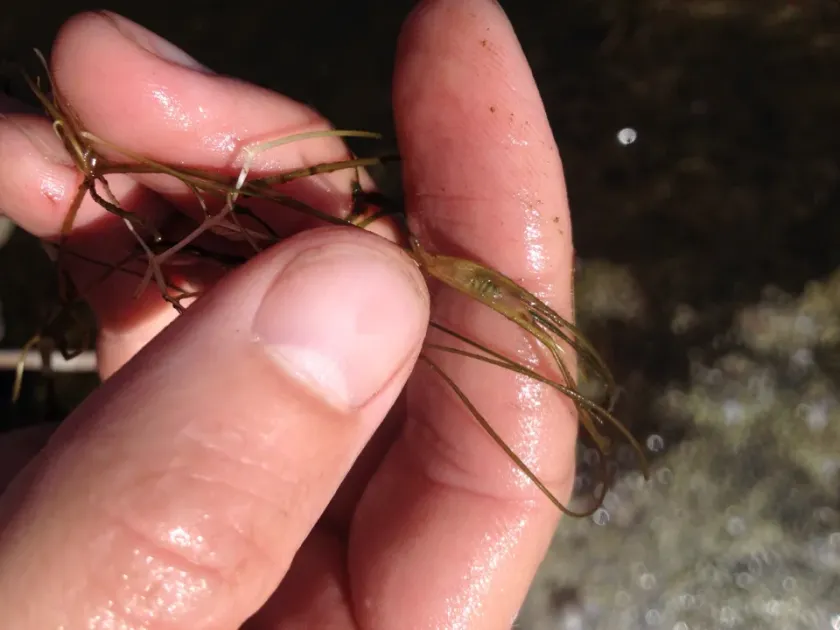
Description
How to tell it apart
Ruppia polycarpa is a perennial submerged aquatic plant belonging to the Ruppiaceae family, known for its dense growth in aquatic environments.
The plant features slender, branched stems that remain fully submerged, often forming complex, tangled mats within the water column.
Its leaves are linear, narrow, and alternate along the stems, which helps the plant maintain flexibility in flowing water conditions.
Flowers are arranged in small spikes on long peduncles, which characteristically coil into a spiral shape to facilitate pollination.
The fruits are small and pear-shaped, carried on elongated stalks, ensuring efficient dispersal of seeds through water currents.
Where it grows
This species typically inhabits brackish water environments, such as coastal lagoons, salt marshes, and saline or alkaline lakes.
In agricultural settings, it thrives in irrigation canals, drainage ditches, and rice paddies, especially where water salinity levels are elevated.
It prefers shallow water areas where light penetration is sufficient to support rapid photosynthetic activity and dense biomass accumulation.
The plant demonstrates high ecological adaptability, surviving significant fluctuations in water levels and salt concentration throughout the growing season.
Growth is most vigorous during the warmer months, coinciding with peak water demand for irrigation in agricultural regions.
Harm it causes
Ruppia polycarpa causes significant damage by obstructing water flow in irrigation canals, which decreases the efficiency of water delivery to crops.
The dense vegetation traps sediment and organic debris, leading to accelerated siltation and higher maintenance costs for hydraulic infrastructure.
In rice production, it acts as a competitor for essential nutrients and sunlight, potentially suppressing rice seedling development in flooded fields.
Decomposing biomass from excessive growth cycles depletes dissolved oxygen in the water, which negatively impacts local aquatic biodiversity.
Clogging of pump station filters and intake screens can lead to mechanical equipment failures and costly operational delays.
How to control
Mechanical control involves the scheduled cutting and removal of weed biomass using specialized aquatic mowers before seed set occurs.
Seasonal drawdown and drying of irrigation channels are highly effective strategies to desiccate the root systems and inhibit regrowth.
Chemical control can be achieved through the application of aquatic-approved herbicides, though this requires careful monitoring to prevent environmental damage.
Integrated management plans often combine mechanical clearing with water velocity adjustments to minimize the conditions favoring the plant's spread.
- Biological control: Introducing herbivorous fish species to mitigate weed biomass in contained systems.
- Prevention: Regular maintenance and reshaping of channel beds to reduce slow-flow zones suitable for colonization.
Taxonomy
- Latin name
- Ruppia polycarpa
- Family
- Руппия
- EPPO code
- RUPPO