
Spiral ditchgrass
Ruppia cirrhosa
Description
How to tell it apart
Spiral ditchgrass (Ruppia cirrhosa) is a perennial submerged aquatic herb belonging to the Ruppiaceae family.
The plant features slender, thread-like stems that are heavily branched, often reaching significant lengths within the water column.
Its leaves are narrow and linear, either alternate or clustered, typically ending in a pointed tip, giving the plant an underwater shrub appearance.
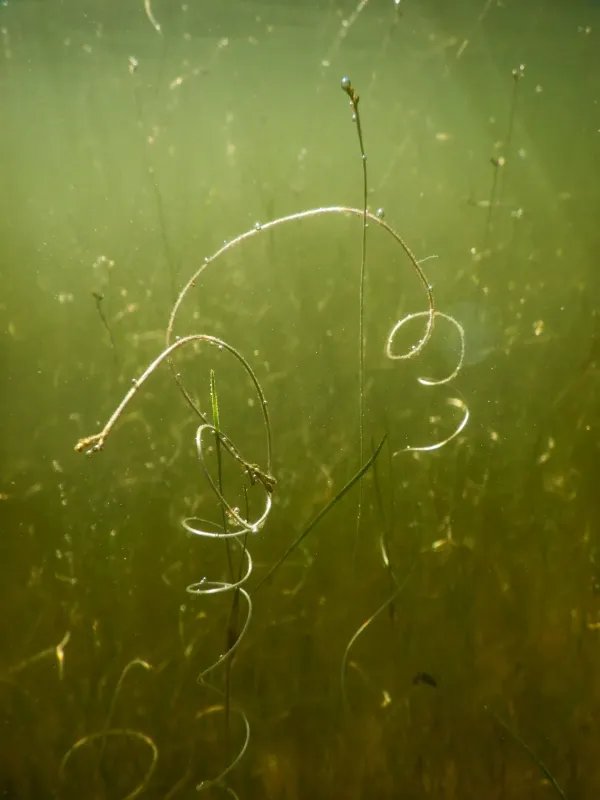
A distinctive feature is its ability to produce spirally coiled flower stalks that push the inflorescences to the surface for pollination.
As a hydrophyte, the plant exhibits remarkable resilience, capable of thriving in environments with varying levels of salinity.
Where it grows
This weed is primarily found in stagnant or slow-moving water bodies, such as brackish lakes, coastal lagoons, and estuaries.
In an agricultural context, Ruppia cirrhosa poses a significant threat to irrigation canals, drainage networks, and flooded rice fields.
The plant prefers silty or sandy substrates, where it establishes a robust root system that facilitates rapid vegetative colonization.
It is frequently observed in regions with intensive irrigation farming, where consistent water levels support year-round growth.
The proliferation of this species in drainage channels leads to significant siltation and obstructs the natural flow of water.
Harm it causes
The primary damage caused by spiral ditchgrass is the massive accumulation of biomass that blocks the flow section of irrigation canals.
This blockage severely reduces the capacity of irrigation infrastructure, disrupting the water supply schedule for agricultural crops.
When infesting rice paddies, the plant competes directly with the crop for essential mineral nutrients, sunlight, and growth space.
The decay of accumulated biomass decreases water oxygen levels, which can negatively affect the overall quality of irrigation water.
Mechanical removal of dense stands in large-scale operations is labor-intensive and requires specialized machinery, increasing farm production costs.
How to control
The primary agronomic control measure is periodic drying of canals, as the desiccation of the substrate is lethal to the plant's rhizomes.
Regular mechanical harvesting using aquatic weed cutters or rakes is essential to prevent the spread and blockage of water channels.
In rice cultivation, deep flooding during critical stages of development is an effective method to suppress the establishment of the weed.
Application of aquatic-approved herbicides, such as those containing glyphosate salts, is effective for controlling localized outbreaks.
Long-term management should include integrated approaches, such as monitoring water salinity levels and maintaining proper hydraulic flow.
Taxonomy
- Latin name
- Ruppia cirrhosa
- Family
- Руппия
- EPPO code
- RUPCI