
Silverweed
Potentilla anserina
Description
How to tell it apart
Silverweed is a perennial herbaceous plant belonging to the Rosaceae family. It is characterized by long, creeping stolons that root at the nodes, allowing the plant to spread rapidly across the soil surface.
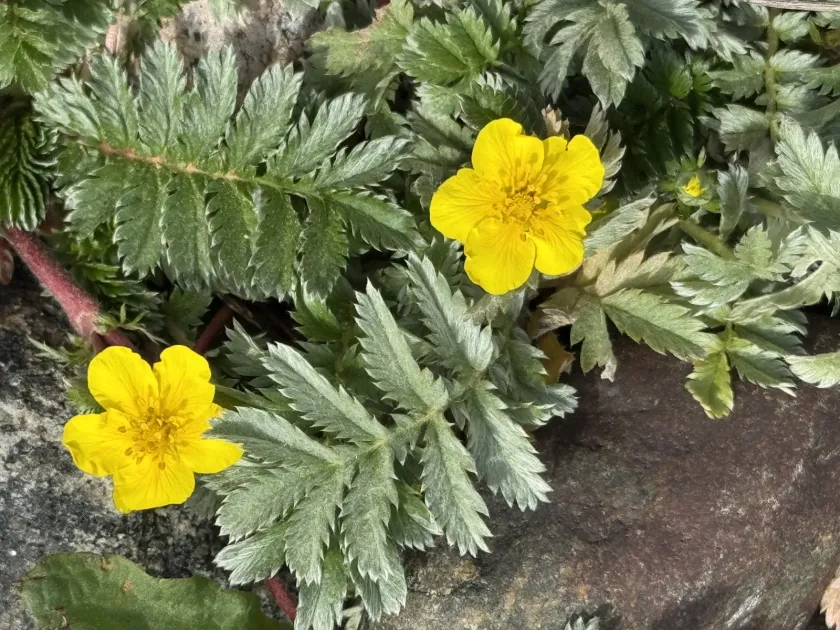
The leaves are pinnate with a distinct silvery, silky pubescence on the underside, which gives the plant its common name. The flowers are solitary, bright yellow, and held on long stalks arising from the leaf axils.
The root system consists of a shallow but extensive network of rhizomes and adventitious roots. The plant is highly resilient and can regenerate even if only a small portion of the stolon remains in the ground.
Silverweed reproduces both through seed production and vigorous vegetative propagation. This dual strategy makes it a persistent and difficult weed to eradicate once established in a field.
It is classified as a perennial rhizomatous weed that thrives in disturbed areas and is known for its ability to form dense, persistent colonies that outcompete native or crop vegetation.
Where it grows
This weed is widely distributed throughout the temperate regions of the Northern Hemisphere. It typically inhabits moist environments such as riverbanks, wet meadows, pastures, and disturbed roadsides.
In agricultural settings, Silverweed is a common pest in vegetable gardens, row crops, and pastures with poor drainage. It favors heavy, compacted soils that are prone to periodic waterlogging.
The plant is highly adaptable to various soil types but flourishes in nutrient-rich, moist areas. It often invades gaps in crop stands where the soil cover is not fully developed.
In permanent pastures, Silverweed often occupies bare patches, gradually expanding into the surrounding turf. Its presence indicates a likely issue with soil moisture management or overgrazing.
Agricultural machinery often facilitates the spread of Silverweed, as tillage equipment can easily break off and transport fragments of the creeping stems to new areas of the field.
Harm it causes
The primary harm caused by Silverweed is direct competition with crops for water, light, and soil nutrients. Dense mats of foliage create a barrier that inhibits the growth of younger crop seedlings.
In forage production, Silverweed reduces the overall quality of hay and pasture. It has lower nutritional value than desirable forage grasses and can significantly lower the yield of high-quality feed.
The dense vegetative cover created by the plant promotes local humidity, which can lead to increased incidence of fungal pathogens that may eventually affect the primary crop.
Silverweed patches can also hinder mechanized harvesting, adding complexity to the process and increasing the moisture content of the harvested crop material.
Its persistence makes it a recurring problem that requires long-term management strategies, increasing the total cost of production for farmers on affected land.
How to control
Cultural control is focused on improving soil drainage and implementing vigorous tillage practices. Deep plowing can help bury and desiccate the rhizomes if performed in dry conditions.
Crop rotation remains an essential tool. Including dense, competitive crops or frequent mechanical weeding in row crops can help suppress the expansion of Silverweed patches over time.
Chemical control often requires systemic herbicides that are capable of translocating to the root system. Applications are most effective during the active growth phase of the plant.
For large-scale management, a combination of chemical treatment and subsequent mechanical cultivation is often necessary to achieve a significant reduction in weed density.
- Implement deep tillage to expose and dry out rhizomes
- Apply systemic herbicides following the label guidelines
- Improve soil drainage to reduce the plant's competitive advantage
- Practice crop rotation to disrupt the weed's life cycle
- Regular inter-row cultivation in row crops
Taxonomy
- Latin name
- Potentilla anserina
- Family
- Розовые
- EPPO code
- PTLAN