
Tall hairy agrimony
Agrimonia gryposepala
Description
How to tell it apart
Tall hairy agrimony (Agrimonia gryposepala) is a perennial herbaceous plant belonging to the Rosaceae family, known for its strong, creeping rhizomes.
The plant typically grows to a height of 1 to 1.5 meters, featuring sturdy, erect stems covered in stiff, glandular hairs.
Its leaves are interruptedly pinnate, consisting of large, serrated leaflets that give the plant a dense and leafy appearance during the growing season.
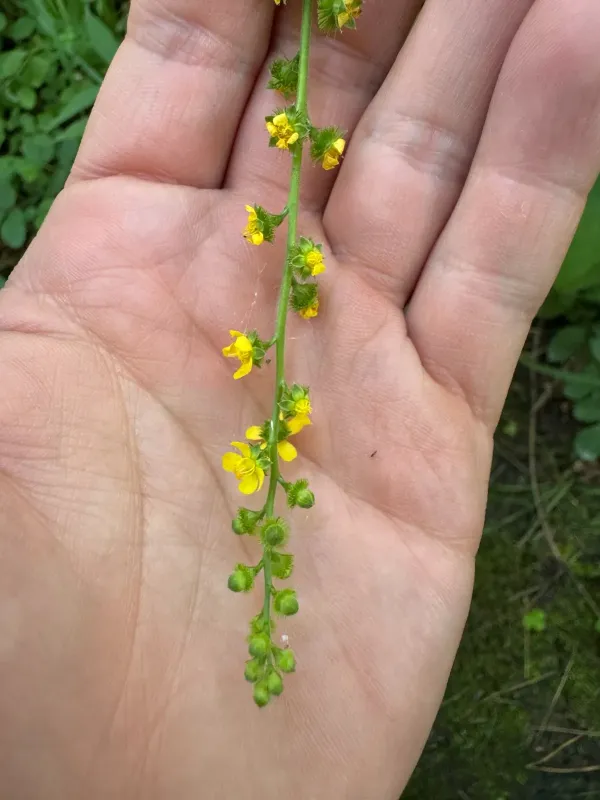
Yellow flowers are arranged in long, spike-like racemes, which are characteristic of this genus and appear throughout the mid-to-late summer.
The fruit is a small, bur-like structure armed with hooked bristles, designed to adhere to animals and clothing for efficient seed dispersal.
Where it grows
This species thrives in nutrient-rich, moist, and well-drained soils, often colonizing woodland edges, thickets, and disturbed areas.
In agricultural settings, it is commonly found invading pastures, perennial forage fields, and field margins near woodland boundaries.
It adapts well to partial shade, making it a persistent weed in fence rows and non-cultivated strips adjacent to arable land.
The seeds are easily transported by farm machinery, facilitating the migration of the weed from wild areas into productive fields.
Its ability to establish dense clusters allows it to outcompete native vegetation and suppress less vigorous crop varieties.
Harm it causes
Tall hairy agrimony acts as a significant competitor for soil moisture and essential mineral nutrients, reducing the yield of nearby crops.
In pasture systems, the hooked seeds (burs) contaminate livestock wool, decreasing the value of the products and increasing labor for grooming.
Presence in forage crops reduces the overall quality of hay, as the tough, hairy stems are unpalatable and potentially harmful to livestock.
The aggressive root system depletes topsoil health, making it difficult for desirable forage or crop plants to establish and maintain density.
Infestations increase the overall cost of weed management, requiring both mechanical removal and potential chemical interventions to clear the land.
How to control
Mechanical control includes deep tillage in the fall to expose and desiccate the rhizomes, effectively preventing regrowth in the following season.
Frequent mowing before seed production is essential to prevent the spread of hooked fruits and to drain the plant's energy reserves over time.
Chemical control can be achieved through the application of selective systemic herbicides designed for broadleaf weeds during the active growth stage.
For persistent or large infestations, spot-spraying with glyphosate-based herbicides can eradicate the plants by killing the root system completely.
- Maintaining strong competitive crop density to suppress weed establishment.
- Cleaning machinery thoroughly when moving from infested areas to clean fields.
Taxonomy
- Latin name
- Agrimonia gryposepala
- Family
- Розовые
- EPPO code
- AGIGR