
Pontederia rotundifolia
Pontederia rotundifolia
Description
How to tell it apart
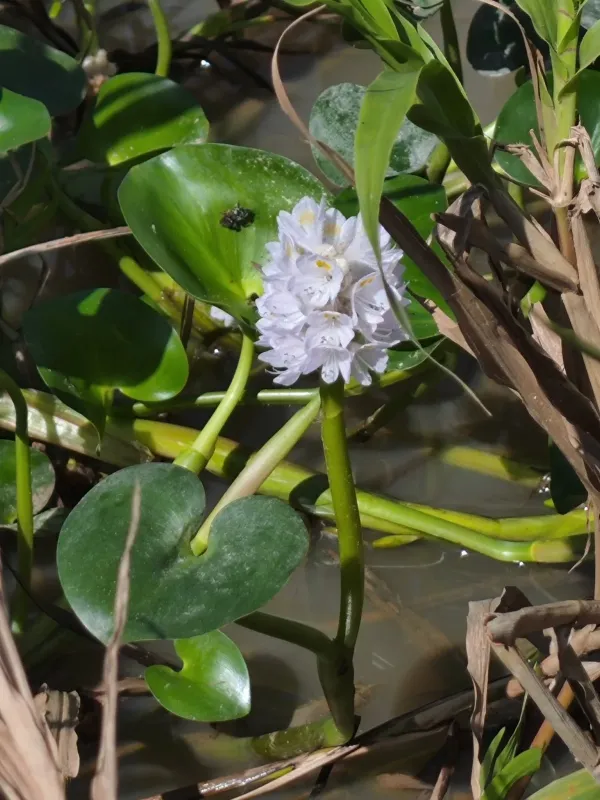
Pontederia rotundifolia is a perennial aquatic or semi-aquatic herb belonging to the Pontederiaceae family. It is easily identified by its heart-shaped or round leaves, which are borne on long petioles and often float on the water surface.
The stems of this plant are succulent and can grow upright, forming dense, impenetrable clusters. The plant features an extensive creeping rhizome system, which provides significant stability and allows for rapid vegetative propagation.
Its flowers are small and arranged in characteristic spike-like inflorescences with a vivid blue or violet color. The flowering period is prolonged, enabling the plant to produce a substantial volume of seeds throughout the growing season.
This species exhibits remarkable ecological plasticity, allowing it to thrive in both fully submerged environments and saturated, muddy riparian zones. This adaptability makes it a highly resilient weed in irrigated systems.
A crucial diagnostic feature is the single-seeded fruit capsule. These capsules are easily dispersed by flowing water, facilitating the colonization of new irrigation channels and downstream agricultural fields.
Where it grows
The primary habitat of Pontederia rotundifolia encompasses tropical and subtropical regions, where it frequently dominates aquatic vegetation in shallow water bodies, river margins, and inundated lowlands.
In agricultural practice, it is recognized as a problematic weed in paddy fields. It is perfectly adapted to the continuous flooding conditions required for intensive rice cultivation, making it a persistent competitor.
The weed often infiltrates fields via irrigation water derived from open channels. Once established in the irrigation infrastructure, it serves as a constant source of re-infestation for surrounding agricultural lands.
Beyond cultivated rice fields, the weed is prevalent in waterlogged fallow lands, drainage ditches, and along the banks of stagnant or slow-moving water bodies, thriving wherever high moisture is maintained.
The weed displays high aggressiveness during the early development stages of rice. Because rice grows slowly initially, the rapid development of the weed grants it a critical advantage in capturing nutrients and light.
Harm it causes
The main threat posed by Pontederia rotundifolia is intense competition with rice plants for space, solar radiation, and nutrients within the paddy environment. This resource competition directly stunts the development of the crop.
Rapid vegetative growth leads to severe shading of rice seedlings. This inhibition results in reduced tillering, lower plant density, and significant gaps in the field, which ultimately lead to major yield losses.
The plant causes significant operational difficulties. Its dense mats physically impede standard maintenance tasks, including fertilizer application, manual weed removal, and the regular clearing of irrigation channels.
Large infestations of this plant drastically reduce the flow capacity of irrigation and drainage systems. This causes water stagnation, which alters the thermal regime of the field and promotes the growth of various rice pathogens.
During the harvest, the presence of this weed complicates the operation of combine harvesters. It clogs harvesting machinery, increases grain moisture content, and forces additional drying costs, lowering the final market value of the harvest.
How to control
Effective management requires an integrated approach that combines cultural practices with the strategic application of herbicides. Maintaining clear irrigation infrastructure is the first line of defense against invasion.
Cultural methods include managing the water levels in the rice paddies. Temporary draining or draw-downs at specific growth stages of the weed can significantly stress the plant and reduce its invasive vigor.
Chemical control focuses on the use of selective herbicides labeled for rice cultivation. Systemic herbicides are the most effective, as they are translocated through the leaves and down into the rhizomes, ensuring complete plant death.
- Rigorous monitoring of fields for early detection of new infestations.
- Using high-quality seed to prevent the introduction of weed seeds.
- Applying systemic herbicides in accordance with regional regulations for rice production.
- Promoting optimal rice planting density to minimize the space available for weed growth.
A successful long-term strategy focuses on depleting the soil seed bank. By preventing the weed from flowering and setting fruit, growers can gradually reduce the population density over several consecutive growing seasons.
Taxonomy
- Latin name
- Pontederia rotundifolia
- Family
- Понтедериевые
- EPPO code
- POFRO