
Pickerelweed
Pontederia cordata
Description
How to tell it apart
Pickerelweed (Pontederia cordata) is a perennial aquatic plant belonging to the family Pontederiaceae, typically found in shallow water habitats.
The plant is distinguished by its heart-shaped or lanceolate leaves that stand on long petioles, rising well above the water surface.
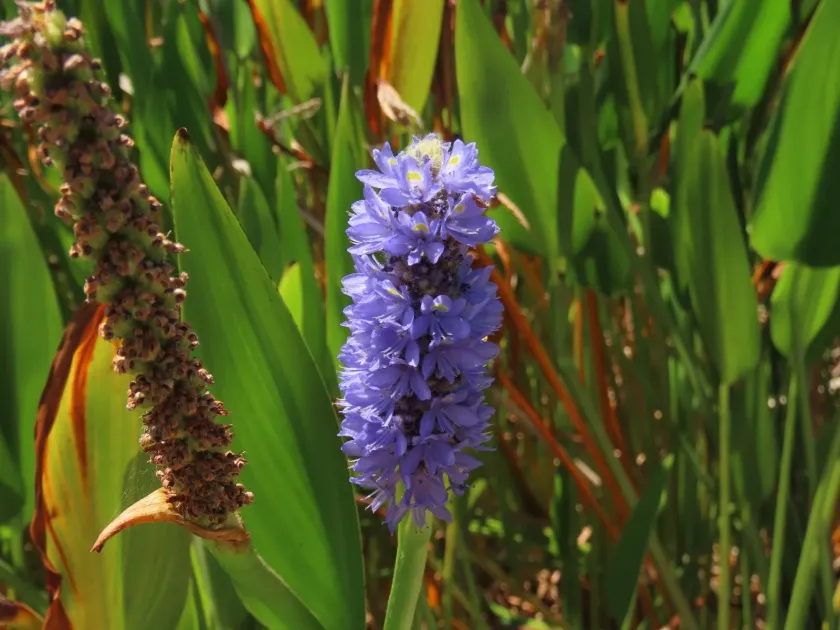
Its inflorescence is a dense, spike-like raceme featuring small, vibrant blue to violet flowers that appear during the growing season.
A robust root system consisting of creeping rhizomes allows the plant to anchor itself firmly in bottom sediments and spread rapidly.
It is classified as an aquatic weed that can dominate shallow water zones, forming dense colonies that outcompete native flora.
Where it grows
The native distribution of Pontederia cordata includes eastern North America, Mexico, Central America, the Caribbean, and South America.
It thrives in stagnant or slow-moving water, including ponds, marshes, and the margins of rivers where nutrient levels are high.
It has been introduced to Europe and Australia, where it is increasingly recognized as a weed in wetland and agricultural water systems.
In agricultural contexts, it frequently invades rice paddies, drainage ditches, and irrigation canals, obstructing water flow.
The plant demonstrates high adaptability to various substrates, growing efficiently in both silty and sandy pond bottoms.
Harm it causes
The primary harm caused by Pickerelweed is the clogging of irrigation and drainage infrastructure, which significantly restricts water flow.
In rice cultivation, it competes aggressively with the crop for sunlight, water, and nutrients, potentially leading to yield losses.
Large infestations accelerate the accumulation of silt and organic debris, leading to the degradation of water quality in ponds and canals.
Its prolific growth can disrupt the ecological balance of water bodies, hindering fishery activities and local water management.
Manual removal is labor-intensive due to the plant's deep and extensive rhizomatous network, making long-term control a complex task.
How to control
Mechanical control involves the complete removal of the plants including rhizomes before the seed production stage to prevent spread.
Water level management, such as temporarily draining or lowering the water in canals, can effectively stress and kill the weed populations.
Chemical control requires the use of specialized aquatic-approved herbicides that minimize damage to the surrounding aquatic ecosystem.
Preventative strategies focus on monitoring irrigation systems for early detection and rapid removal of newly established clusters.
- Regular mechanical cutting and dredging.
- Manipulation of water depth in managed systems.
- Targeted use of selective aquatic herbicides.
- Implementation of regular field and canal inspections.
Taxonomy
- Latin name
- Pontederia cordata
- Family
- Понтедериевые
- EPPO code
- POFCO