
Murdannia nudiflora
Murdannia nudiflora
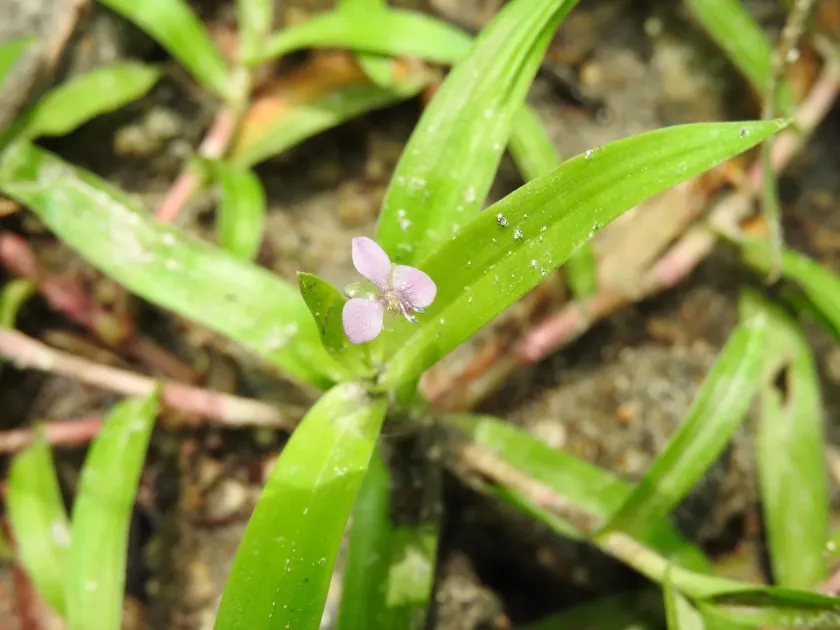
Description
How to tell it apart
Murdannia nudiflora, commonly known as doveweed, is an annual herbaceous plant belonging to the Commelinaceae family. It is characterized by its prostrate or ascending stems, which frequently root at the nodes, facilitating rapid vegetative spread across soil surfaces.
The leaves are lanceolate to linear-lanceolate, alternate, and feature distinct sheaths at the base. Small, delicate flowers grow in loose clusters at the tips of the stems, showcasing shades of pink, violet, or lavender.
The root system is fibrous and shallow but remarkably tenacious. Because each node can potentially form roots, the plant is difficult to eradicate through simple mechanical pulling, as any fragment left in the soil can regenerate.
As a moisture-loving species, it thrives in environments with high humidity and abundant water. It reproduces primarily through small seeds that remain viable in the soil for several years, creating a persistent seed bank.
The plant grows vigorously during warm, humid seasons, rapidly covering bare soil or competing with young crops in fields where moisture levels are consistently high.
Where it grows
Murdannia nudiflora is a prevalent weed in tropical and subtropical regions, particularly problematic in rice paddies, moist lowlands, and the margins of irrigation channels.
In intensive agriculture, it is frequently found infesting fields of rice, soybeans, and maize, especially in areas with poor drainage or where over-irrigation occurs.
The weed is highly adaptive to various soil types provided that a high degree of moisture is maintained, making it a significant challenge in irrigated agricultural systems worldwide.
Seed dispersal is largely facilitated by irrigation water, which carries the small seeds across fields, as well as by agricultural machinery that transports seeds and plant fragments between locations.
Climate change and the expansion of irrigated land areas are contributing to the wider distribution of this species, allowing it to colonize new agricultural zones previously unaffected by the weed.
Harm it causes
The primary damage caused by Murdannia nudiflora is its intense competition with crops for sunlight, space, and nutrients during critical early growth stages, leading to significant yield suppression.
By forming a dense mat over the ground, the weed impedes soil aeration and interferes with the root development of the primary crop, often resulting in stunted growth and weakened plants.
In rice cultivation, the presence of doveweed creates an environment conducive to fungal infections, as the dense foliage traps humidity and limits airflow around the base of the crop.
The high nutrient uptake of the weed forces farmers to increase fertilizer applications to compensate for losses, significantly driving up production costs and reducing overall profitability.
During harvest, this weed clogs agricultural machinery, increasing the time required for harvesting and leading to issues with grain moisture levels, which requires expensive post-harvest cleaning and drying.
How to control
Effective management begins with crop rotation and the use of competitive cover crops that can outgrow and shade out the weed, limiting its access to necessary light for germination.
Agronomic control strategies include thorough soil preparation, such as deep plowing to bury the seeds, and timely mechanical weeding or inter-row cultivation during the early growth of the crop.
Water management is crucial; implementing proper drainage systems in rice fields to avoid prolonged waterlogging makes the environment less favorable for the weed's aggressive spread.
Chemical control is an essential tool, utilizing selective systemic herbicides to target the weed; however, effectiveness is highest when treatments are applied during the very early vegetative stages.
- Implement strict sanitation measures for all field machinery.
- Perform timely inter-row cultivation before the crop canopy closes.
- Apply pre-emergence herbicides to prevent seed germination.
- Use post-emergence herbicides when the weed is in the 2-4 leaf stage.
- Monitor and control weeds along the borders of irrigation canals.
Taxonomy
- Latin name
- Murdannia nudiflora
- Family
- Коммелиновые
- EPPO code
- MUDNU