
Commelina diffusa
Commelina diffusa
Description
How to tell it apart
Commelina diffusa, commonly known as spreading dayflower, belongs to the Commelinaceae family. It is an annual herbaceous plant with sprawling stems that frequently root at the nodes, allowing it to colonize soil surfaces rapidly.
The leaves are alternate, lanceolate or ovate-lanceolate in shape, with an acute tip. A key identifying feature is the presence of fine hairs on the leaf sheath, which distinguishes it from similar species in the field.
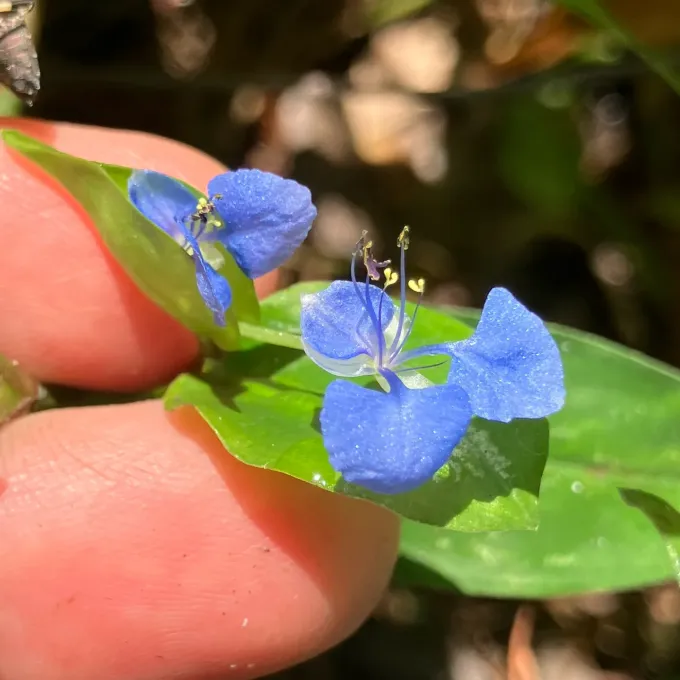
The flowers are distinct, appearing in axillary inflorescences enclosed by a folded spathe-like bract. The corolla consists of three petals: two large and bright blue, and one significantly smaller and pale-colored petal.
The root system is fibrous and highly regenerative. Even small stem fragments containing nodes can successfully root in moist soil, making mechanical eradication particularly difficult without removing the entire plant structure.
Seeds are produced in small capsules and possess high longevity. They can persist in the soil seed bank for several years, allowing for population resurgence even after successful initial herbicide treatments.
Where it grows
Commelina diffusa thrives in moist, fertile soils. It is widely distributed across tropical and subtropical regions, frequently colonizing irrigated agricultural fields, ditch banks, and moist wasteland areas.
The weed poses a significant threat to row crops such as soybeans, corn, sugarcane, and cotton. Its ability to grow rapidly under warm, humid conditions allows it to outcompete emerging crop seedlings for vital resources.
It is commonly found in disturbed soils, along roadsides, and in areas with intensive irrigation practices. The plant shows high plasticity regarding shade tolerance, enabling it to persist and thrive even beneath the canopy of maturing crops.
Under consistent irrigation, Commelina diffusa often becomes the dominant weed species, outcompeting less aggressive flora. Its presence often indicates excessive soil moisture or inefficient water management in the field.
Seed dispersal is facilitated by both irrigation water and mechanical equipment, as stem segments can easily adhere to machinery, transporting the plant to new, uninfested areas of the farm.
Harm it causes
The primary damage caused by Commelina diffusa is aggressive competition for soil nutrients, water, and sunlight. Its rapid vegetative spread creates dense mats that effectively shade out young crop seedlings, stunting their initial growth.
The weed serves as an alternative host for various pests and plant pathogens. Studies have shown that it can harbor viruses and fungal diseases that later migrate to primary crops, complicating overall plant health management.
Infestations of this weed significantly hinder mechanical harvesting operations. The large, succulent biomass of the plant clogs combine headers, reduces operating speeds, and leads to increased harvest losses.
The presence of this weed reduces crop quality. In soybean fields, for instance, high levels of Commelina biomass can increase the moisture content of the harvested grain, necessitating additional drying and cleaning costs.
Economic losses are compounded by the high cost of supplemental herbicide applications, as the plant exhibits partial tolerance to many standard herbicides due to its waxy leaf surface and morphological adaptations.
How to control
Mechanical control measures include deep plowing to bury the weed seeds and prevent early establishment. Timely inter-row cultivation is essential to disrupt root formation before the stems establish strong connections at the nodes.
Crop rotation is a recommended strategy to manage populations. Utilizing competitive crops that create a dense canopy can significantly suppress Commelina development, as the weed requires sufficient light to maximize its growth potential.
Chemical control often requires the use of combined herbicide programs. Glyphosate-based products frequently show insufficient efficacy on established, mature plants, necessitating the use of tank mixes with broader-spectrum herbicides.
Selective herbicides are used for post-emergence control in broadleaf crops, but the hairy surface of the leaves can limit absorption, making the use of high-quality adjuvants mandatory for successful penetration.
- Utilize surfactants to improve herbicide adhesion and leaf surface wetting.
- Perform treatments during early developmental stages, preferably before active branching.
- Combine systemic and contact-acting herbicides to effectively target both foliage and root systems.
Taxonomy
- Latin name
- Commelina diffusa
- Family
- Коммелиновые
- EPPO code
- COMDI