
Carpetweed
Mollugo verticillata
Description
How to tell it apart
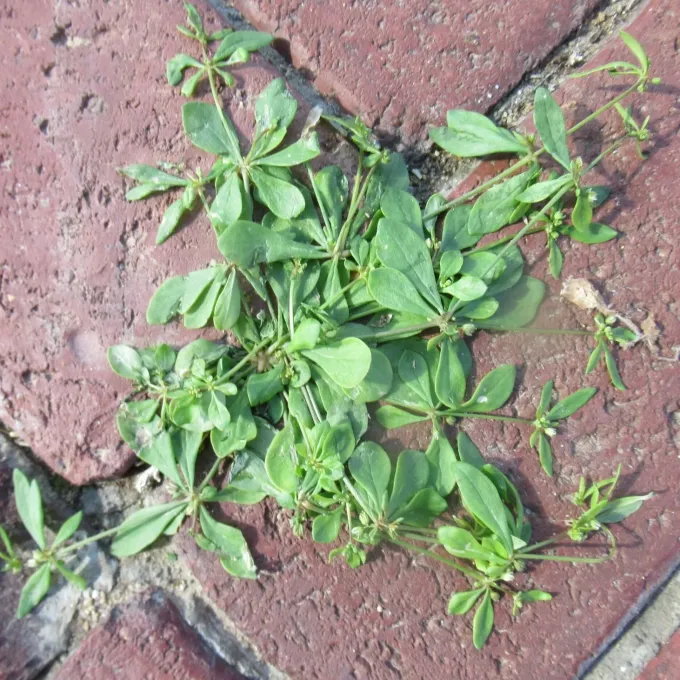
Carpetweed (Mollugo verticillata) belongs to the Molluginaceae family. It is an annual, prostrate herb that typically spreads in a mat-like fashion across the soil surface.
The stems are smooth and branched, often reaching lengths of 8 to 12 inches. Leaves are arranged in whorls at the nodes and possess a distinct linear-lanceolate shape.
Small, white, or greenish-white flowers develop in clusters in the leaf axils, blooming from mid-summer through the late autumn months.
The root system is primarily taprooted but remains shallow, allowing the plant to rapidly establish itself in moist and well-disturbed soil environments.
Carpetweed is highly prolific, with a single plant capable of producing thousands of tiny, reddish-brown seeds, contributing to a substantial soil seed bank.
Where it grows
This species thrives in loose, sandy, or loamy soils and is frequently encountered in cultivated fields, gardens, roadsides, and open, sunny areas.
It is a significant pest in row crops like corn, sunflowers, and various vegetables, where it competes aggressively for moisture during the germination phase.
Carpetweed is highly adaptable to irrigated agricultural settings, where consistent moisture levels allow it to form dense carpets that completely choke out young crop seedlings.
It acts as a pioneer species in disturbed areas, quickly colonizing exposed soil before native or crop vegetation can fully establish a canopy.
The weed is widely distributed across temperate and warm-climate regions, often appearing in massive numbers following rainfall events.
Harm it causes
The primary damage caused by carpetweed is the severe depletion of soil moisture, which poses a significant threat to young crops during periods of heat stress.
Its sprawling growth pattern provides intense physical competition, shading out young plants and restricting the development of their secondary root systems.
Carpetweed serves as a common host for various agricultural pests and viral pathogens that can compromise the health of neighboring cash crops.
Heavy infestations make mechanical weeding and cultivation difficult, as the tangled mats of foliage can easily clog machinery and interfere with precision farming.
The massive production of seeds ensures that once carpetweed is established in a field, it remains a persistent management challenge for several years.
How to control
Mechanical cultivation remains the most effective immediate control method, as breaking the soil surface disrupts the plant's shallow roots and prevents further spreading.
Crop rotation with dense-canopy plants can naturally suppress carpetweed by significantly reducing the amount of sunlight reaching the soil surface.
Chemical control is most successful when utilizing pre-emergent herbicides that create a barrier, stopping the germination of weed seeds in the topsoil layer.
Post-emergent herbicide applications should be timed carefully to address the weed while it is still in the rosette stage, before it develops its expansive mat growth.
- Regular mechanical hoeing in row crops.
- Pre-emergent herbicide applications according to crop labels.
- Maintaining healthy crop vigor to outcompete weed seedlings.
- Sanitation of equipment to prevent the spread of seeds between fields.
Taxonomy
- Latin name
- Mollugo verticillata
- Family
- Моллюгиновые
- EPPO code
- MOLVE