
Mollugo nudicaulis
Mollugo nudicaulis
Description
How to tell it apart
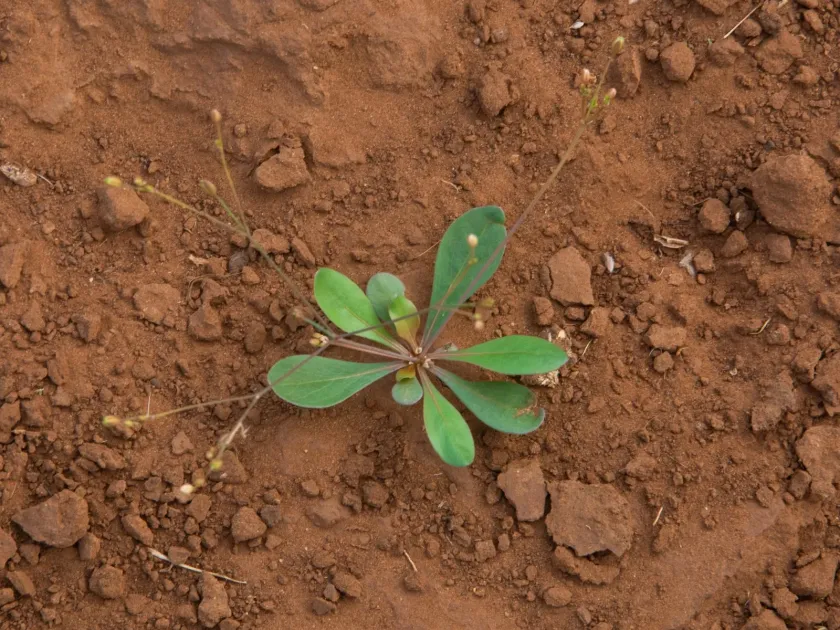
Mollugo nudicaulis, commonly known as naked-stemmed carpetweed, is a herbaceous annual plant belonging to the Molluginaceae family. It is characterized by a dense basal rosette of leaves from which long, leafless flower stalks emerge.
The leaves are typically spatulate or obovate in shape and press firmly against the soil surface. This growth habit allows the weed to claim territory rapidly, effectively shading out other competing seedlings.
The flowers are small and inconspicuous, occurring in loose clusters at the tips of slender stems. Upon maturity, the plant produces numerous tiny seeds contained within small capsules that burst open to scatter seeds widely.
A taproot system supports the plant, allowing it to tap into moisture stored in deeper soil layers. This gives it a competitive advantage in sandy or poor-quality soils where other plants struggle.
Because it grows low to the ground, it can easily escape initial mechanical cultivation efforts if the equipment blades are set too high, allowing the plant to recover and set seed.
Where it grows
This weed is commonly found in tropical and subtropical regions. It thrives in open, disturbed areas such as agricultural fields, pastures, roadsides, and abandoned construction sites.
Mollugo nudicaulis prefers well-drained, sandy, or light-textured soils. It is frequently identified as a nuisance in vegetable gardens, orchards, and irrigated row crop systems.
The plant is highly adaptable to varied sunlight conditions, though it flourishes most in full sun. Its ability to tolerate short-term dry spells allows it to colonize regions with unpredictable rainfall.
It often appears in large numbers following soil tillage, as the disturbance provides the necessary exposure to light for its seeds to germinate successfully.
In intensive farming environments, the weed exploits irrigation cycles, growing rapidly between crop rows where water and fertilizers are readily available.
Harm it causes
The primary damage caused by Mollugo nudicaulis is its aggressive competition with crop plants for water and soil nutrients, which can lead to significant stunting of young seedlings.
Due to its rosette formation, it creates a surface barrier that interferes with proper soil aeration. This micro-environment can increase local humidity, potentially encouraging soil-borne fungal pathogens.
The weed acts as a host for various insects and plant diseases, which can then spread to cultivated crops, resulting in reduced yields and poorer produce quality.
In vegetable production, it significantly increases labor costs, as it often requires hand-weeding to remove individuals that survive between rows where mechanical hoes cannot reach.
Seed contamination of the final harvest is a major economic issue, as it lowers the market value and requires additional processing steps to clean the agricultural products.
How to control
Effective agricultural control involves timely inter-row cultivation. By uprooting the basal rosettes during the early growth stage, farmers can prevent the plant from establishing a firm grip on the soil.
Cultural methods, such as using dense cover crops or organic mulch, are highly effective. These practices block the light needed by Mollugo nudicaulis seeds to germinate, effectively suppressing the population.
Chemical control usually involves the application of pre-emergent or post-emergent herbicides. It is vital to apply these treatments when the weed is in its early growth phase to ensure maximum efficacy.
Rotating crops and maintaining healthy, competitive crop stands helps to naturally limit the spread of this weed, as it struggles to grow in areas with thick foliage cover.
- Regular mechanical weeding and soil cultivation.
- Application of selective herbicides during the seedling stage.
- Use of mulching to prevent light penetration to seeds.
- Maintaining high soil fertility to promote rapid growth of the main crop.
Taxonomy
- Latin name
- Mollugo nudicaulis
- Family
- Моллюгиновые
- EPPO code
- MOLNU