
Hypertelis cerviana
Hypertelis cerviana
Description
How to tell it apart
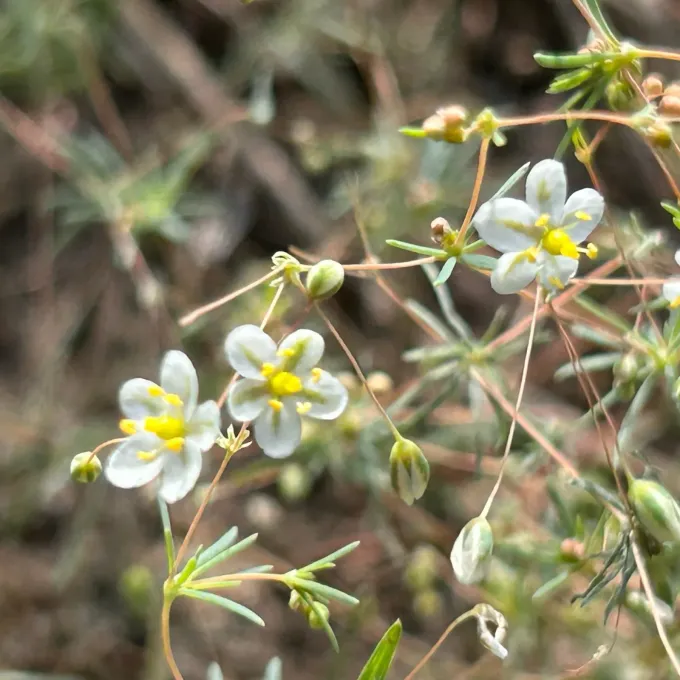
Hypertelis cerviana, belonging to the Molluginaceae family, is an annual herbaceous weed characterized by its small, unassuming appearance and slender, whorled leaves.
The plant typically reaches a height of 10 to 20 cm, with stems that can be erect or prostrate depending on the surrounding environmental density and soil conditions.
The leaves are linear and arranged in distinct whorls around the stem, a morphological feature that makes the plant relatively easy to recognize once one is familiar with the species.
Flowers are small, greenish-white, and clustered in umbel-like inflorescences at the tips of the branches, usually appearing during the peak of the summer growing season.
Its root system is a modest taproot, which allows the plant to thrive in sandy substrates but also makes it vulnerable to mechanical weeding methods during early development.
Where it grows
This species is highly adapted to sandy, loamy, and nutrient-poor soils, making it a common sight in fields that are not optimally fertilized or have light soil textures.
It is frequently observed in open habitats such as sandy plains, roadsides, and fallow lands, which act as primary seed sources for encroachment into agricultural zones.
The plant demonstrates high tolerance to drought and heat, allowing it to dominate in arid agricultural areas where other more demanding weed species fail to survive.
It often establishes itself in vegetable crops and cereal fields, particularly in regions where intensive soil disturbance promotes the germination of seeds stored in the soil bank.
In addition to cultivated fields, it thrives in abandoned pasture land and dry, disturbed sites where there is minimal competition from perennial grasses or shrubs.
Harm it causes
The weed competes significantly with crops for soil moisture and available mineral nutrients, which can lead to reduced biomass in the main crop, especially in sandy soils.
Due to its ability to form dense patches, it can create shade for emerging seedlings, leading to stunted development and increased susceptibility to secondary plant diseases.
The presence of Hypertelis cerviana in the field often necessitates additional cleaning cycles for harvested produce, as its small seeds are difficult to separate from small-seeded crops.
It can host various agricultural pests, providing them with a habitat and food source before they migrate to the cash crop, thus increasing the risk of widespread infestation.
While individually small, its rapid life cycle and ability to set seeds in poor conditions mean that it can quickly become a persistent problem if left uncontrolled for several seasons.
How to control
Mechanical control, including thorough harrowing and inter-row cultivation, is effective for managing populations before the weed reaches the flowering stage.
Integrating diverse crop rotations helps to suppress Hypertelis cerviana by disrupting its life cycle and using competitive crops that shade out the soil surface.
Chemical control involving selective herbicides is possible; however, applications must be timed with the weed's early developmental stages to ensure maximum efficacy.
Preventative measures, such as cleaning agricultural machinery between fields, are essential to avoid the spread of seeds, which are easily transported by wind or mud.
Maintaining soil fertility and structural health helps the desired crop outcompete the weed, significantly reducing the pressure from this species over long-term cultivation cycles.
Taxonomy
- Latin name
- Hypertelis cerviana
- Family
- Моллюгиновые
- EPPO code
- MOLCE