
Helenium hoopesii
Helenium hoopesii
Description
How to tell it apart
Helenium hoopesii, commonly known as Orange sneezeweed, is a perennial herbaceous plant belonging to the Asteraceae family. It typically grows to a height of 50 to 90 cm with sturdy, branched stems.
The leaves are lanceolate or elliptical with entire margins, covered in small glandular dots. Basal leaves form a rosette, while the stem leaves are arranged in an alternate pattern.
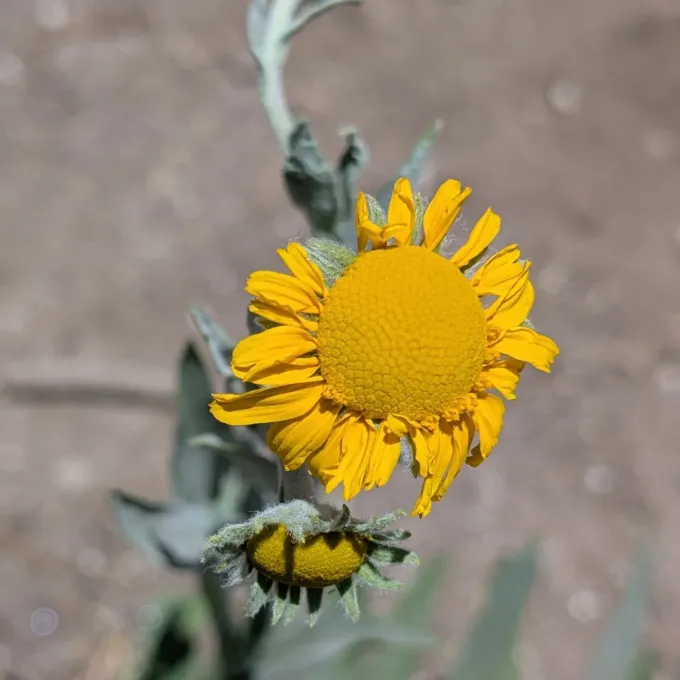
The inflorescences are large flower heads, 6–8 cm in diameter, featuring a vibrant yellow or orange color. The ray florets are often drooping, which is a distinctive characteristic of the genus.
Flowering occurs from mid to late summer, followed by the development of achenes equipped with a pappus of scales, facilitating wind dispersal over significant distances.
The plant possesses a robust root system, granting it high regenerative capacity and the ability to persist even under harsh environmental conditions or after mechanical disturbance.
Where it grows
In its native range, Helenium hoopesii is found in mountainous regions of North America, particularly in alpine meadows and subalpine slopes with adequate moisture.
In agricultural settings, this weed thrives in moist, well-drained soils. It frequently invades fallow fields, pastures, and areas along irrigation ditches or roadsides.
It poses a significant threat to perennial hayfields and grazing lands, where it competes aggressively with desirable forage grasses, leading to reduced overall land productivity.
The weed spreads effectively through both vegetative propagation via its root system and through seed dispersal, which can be accelerated by farm machinery moving through infested areas.
The presence of Helenium hoopesii often indicates soil conditions that are conducive to its rapid colonization, making it difficult to eradicate once it becomes established in a forage stand.
Harm it causes
The primary concern regarding Helenium hoopesii is its toxicity to livestock. The plant contains sesquiterpene lactones that are poisonous to cattle and sheep.
Ingestion by livestock causes a condition often referred to as "sneezeweed poisoning" or "spewing sickness," characterized by loss of appetite, coordination problems, and digestive issues.
Beyond its direct toxicity, the weed acts as a strong competitor for nutrients and water, reducing the yield of beneficial forage crops and decreasing the nutritional value of hay.
High infestations can complicate harvesting procedures and lead to economic losses due to the necessity of cleaning the harvest or disposing of contaminated hay batches.
Persistent infestations often require comprehensive management strategies, as the weed can significantly degrade the botanical composition of pastures over time.
How to control
Mechanical control focuses on deep cultivation or repeated cutting of the plants before they reach the flowering stage to deplete the root reserves and prevent seed formation.
Effective pasture management includes maintaining competitive ground cover to prevent the establishment of the weed and ensuring timely grazing rotations to manage its density.
In crop fields, implementing diverse crop rotations and consistent inter-row cultivation helps in suppressing Helenium hoopesii populations by disrupting its life cycle.
Chemical control involves the application of selective herbicides designed to target broad-leaved weeds in pastures and non-crop areas, usually applied during the active growth phase.
- Application of 2,4-D based herbicides for pasture weed management.
- Use of glyphosate-based non-selective herbicides in fallow or non-agricultural areas.
- Monitoring fields to prevent new colonization from wind-dispersed seeds.
Taxonomy
- Latin name
- Helenium hoopesii
- Family
- Прочие
- EPPO code
- HENHO