
Prostrate spurge
Euphorbia thymifolia
Description
How to tell it apart
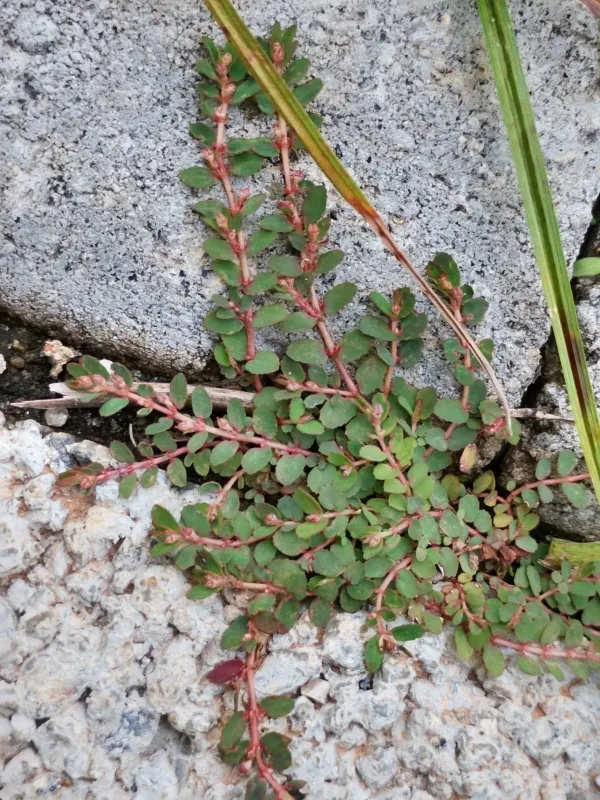
Prostrate spurge (Euphorbia thymifolia) is a prostrate annual herb belonging to the Euphorbiaceae family. Its stems are slender, branched, and often have a reddish or purplish appearance, spreading flat along the ground.
The leaves are small, opposite, and oblong or oval, resembling those of thyme, which is the origin of its common name. A notable diagnostic feature is the presence of a small, dark red or blackish spot often found on the leaf surface.
As with all members of the Euphorbia genus, the plant exudes a milky latex when broken. This latex can be irritating to the skin and toxic if ingested, serving as a defensive mechanism against herbivores.
The inflorescences are inconspicuous, tucked in the leaf axils, producing small capsules containing numerous tiny seeds. The plant has a robust taproot system that allows it to thrive in compacted or dry soils.
It is classified as a warm-season annual, showing rapid growth and prolific seed production during the peak of summer, often dominating disturbed soil surfaces.
Where it grows
This weed is commonly found in tropical and subtropical regions but has successfully expanded into temperate agricultural areas worldwide. It prefers high-light environments and thrives in disturbed, open soil.
In agricultural settings, it is a significant nuisance in row crops such as soybeans, corn, and various vegetable crops. It quickly colonizes spaces between rows where crop canopy closure is delayed.
Prostrate spurge is often found along field margins, roadsides, and irrigation channels, which act as primary sources for the spread of seeds into cultivated fields via wind, water, or machinery.
It is highly adaptable and can be found in various soil types, though it is particularly competitive in sandy or loam soils that are prone to warming quickly under the sun.
Because of its low-growing habit, it often escapes detection by standard scouts until it has already formed extensive mats, complicating control efforts later in the season.
Harm it causes
The primary damage caused by Prostrate spurge is its competitive impact on crop resources. It acts as a significant drain on soil moisture and nutrients, particularly in fields with low plant density.
By forming dense mats, the weed creates a physical barrier that prevents light from reaching the soil, potentially inhibiting the germination and early growth of neighboring crops.
The latex produced by the plant is toxic to livestock. Contamination of forage or hay with significant amounts of this weed can lead to digestive issues or systemic poisoning in grazing animals.
The weed interferes with mechanized harvesting, as its tough, prostrate stems can wrap around equipment parts, leading to frequent downtime and increased wear on machinery.
Its prolific seed production ensures that it can re-establish itself rapidly, building a persistent soil seed bank that makes eradication a multi-year challenge for farmers.
How to control
Effective management begins with mechanical control, such as timely inter-row cultivation. Cutting the plant before it sets seed is essential to prevent future infestations.
Cultural control strategies involve maintaining a healthy crop stand to achieve quick canopy closure, which effectively shades out the light-dependent Prostrate spurge seedlings.
Chemical control should be implemented early. Post-emergence herbicides are most effective when the weeds are in the seedling stage, as mature plants develop waxier leaves that reduce herbicide absorption.
Integration of pre-emergence herbicides can provide long-lasting control, especially in fields with a history of high weed pressure, preventing the germination of seeds in the top soil layer.
- Regular mechanical cultivation between rows.
- Application of selective post-emergence herbicides.
- Sanitation of field borders to minimize spread.
- Strategic crop rotation to break the weed life cycle.
Taxonomy
- Latin name
- Euphorbia thymifolia
- Family
- Молочайные
- EPPO code
- EPHTH