
Prostrate spurge
Euphorbia prostrata
Description
How to tell it apart
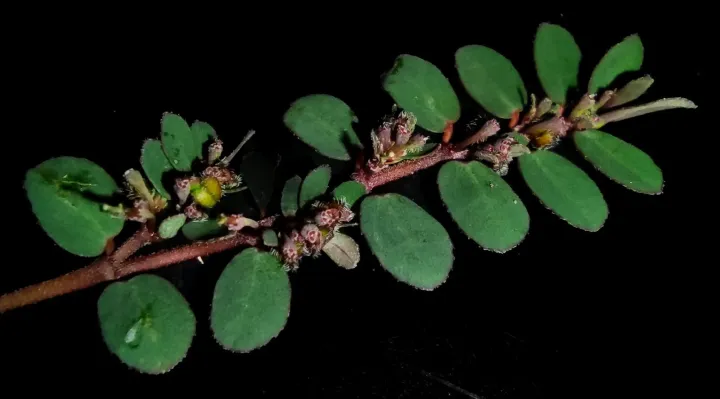
Prostrate spurge (Euphorbia prostrata) belongs to the Euphorbiaceae family. It is a prostrate, mat-forming annual weed that grows close to the ground, often creating dense patches in open areas.
The stems are typically reddish or purple, branched from the base, and contain a characteristic milky white sap that exudes when the plant tissue is broken or cut.
The leaves are opposite, small, oblong-ovate, and have entire or finely serrated margins. Small stipules are often present at the base of the leaf stalks, which is a key botanical feature.
Flowers are tiny and clustered in structures called cyathia located in the leaf axils. The plant flowers continuously throughout the summer, producing a large amount of seeds.
The fruit is a small, three-lobed capsule that bursts at maturity, effectively dispersing seeds over a surrounding area to ensure the propagation of the species.
Where it grows
This weed thrives in sunny, dry locations with light, sandy, or disturbed soils. It is frequently found in row crops, vegetable fields, vineyards, and ornamental garden beds.
Prostrate spurge is a common colonizer of roadsides, wasteland, and compacted soil areas, from where it spreads easily into cultivated fields via machinery and human activity.
The plant is highly drought-tolerant, allowing it to dominate areas where other vegetation may struggle due to moisture stress or excessive heat during the summer months.
In irrigated farming systems, prostrate spurge can rapidly colonize bare ground between crop rows, forming extensive mats that compete with the developing crop.
It is particularly problematic in systems with long fallow periods or where soil management practices leave significant portions of the field surface exposed to light.
Harm it causes
The primary damage is direct competition with crops for soil moisture, light, and mineral nutrients, leading to significant yield losses if left uncontrolled.
Dense mats of the weed act as a physical barrier that prevents soil warming, which can delay the germination and initial establishment of delicate vegetable crops.
The milky sap contains latex that can cause skin irritation, contact dermatitis, or eye inflammation for workers during manual weeding or harvesting processes.
The plant serves as a host for various insect pests and plant viruses, acting as a reservoir that facilitates the infection of adjacent commercial crops.
Harvesting efficiency is often reduced because the dense, low-growing mats clog machinery components, requiring extra cleaning and sorting of the harvested product.
How to control
Effective agrotechnical control starts with deep fall plowing, which buries seeds and disturbs the growth cycle of seedlings before they can establish in the following season.
Mechanical control, such as timely inter-row cultivation, is essential to destroy the mats and prevent the plant from flowering and releasing new seeds into the seed bank.
Chemical control involves the use of selective herbicides applied early in the growth stage, as mature plants are significantly more resistant to standard treatments.
- Pre-emergence herbicide applications to suppress germination.
- Post-emergence treatment with targeted herbicides in row crops.
- Maintaining competitive crop density to shade out spurge growth.
Integrated weed management, combining crop rotation and precise chemical applications, is required to prevent the long-term buildup of Euphorbia prostrata populations.
Taxonomy
- Latin name
- Euphorbia prostrata
- Family
- Молочайные
- EPPO code
- EPHPT