
Boerhavia erecta
Boerhavia erecta
Description
How to tell it apart
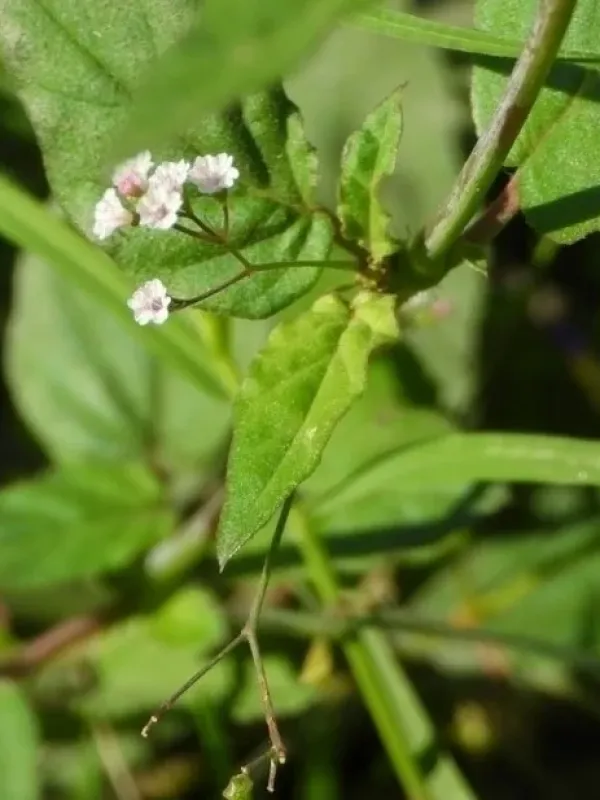
Boerhavia erecta, commonly known as erect spiderling, is an annual or perennial herbaceous plant belonging to the Nyctaginaceae family. Its stems are ascending or erect, often branching from the base, reaching heights between 30 to 80 centimeters.
The leaves are opposite, with a shape ranging from ovate to oblong-lanceolate. The surface is typically green, sometimes tinged with red, with a lighter underside often covered in small glandular hairs.
The flowers are minute and clustered in loose panicles. The perianth has a distinct bell or funnel shape and is pale pink or white in color. Flowering occurs throughout most of the growing season.
The plant has a robust taproot system that penetrates deep into the soil, providing high resilience and survival capabilities even during prolonged periods of drought.
The fruits are small, five-ribbed, sticky achenes that easily adhere to clothing or animal fur, which facilitates the rapid dispersal of seeds to new areas.
Where it grows
This weed is a cosmopolitan species found primarily in tropical and subtropical regions across the globe. It thrives in various environments where warm conditions allow for continuous growth.
Boerhavia prefers open, sunlit areas with sandy or loamy soils, although it is highly adaptable to a wide range of soil types and environmental conditions.
It frequently infests row crops such as corn, soybeans, cotton, and various vegetable farms where gaps in plant spacing allow the weed to establish itself rapidly.
The weed often colonizes roadsides, abandoned fields, waste ground, and garden areas, serving as a constant seed bank for future infestation of agricultural land.
Due to its high level of adaptation to human-disturbed habitats, it quickly occupies land where the natural soil cover has been removed or damaged.
Harm it causes
The primary damage caused by Boerhavia erecta is its aggressive competition for water and soil nutrients, which is particularly detrimental in arid or semi-arid agricultural regions.
The plant grows rapidly, forming dense vegetation that shades out crop seedlings, significantly inhibiting their growth during early development stages and lowering yield potential.
As an alternative host for various insect pests and viral pathogens, this weed plays a role in maintaining high disease pressure within agricultural landscapes.
Infestation of fields by this weed complicates mechanical harvesting, as the thick vegetation can clog the moving parts of agricultural machinery.
The presence of sticky seeds reduces the quality of harvested grains and other crops, necessitating additional cleaning and processing costs after harvest.
How to control
Agronomic control measures include deep plowing, which serves to sever the deep taproot system and prevent regrowth from the plant's perennating buds.
Regular inter-row cultivation during the early stages of crop growth effectively destroys young seedlings before they reach the flowering stage.
Crop rotation incorporating dense-canopy crops is an essential strategy, as the resulting shade effectively suppresses the growth of light-dependent Boerhavia.
Chemical control strategies involve the use of systemic broad-spectrum herbicides during the plant's active growth phase, before it sets seed.
- Pre-emergence soil-applied herbicides to suppress germination.
- Post-emergence selective herbicides applied according to label rates for the specific crop.
- Timely mowing of field borders and non-crop areas to prevent seed production.
Taxonomy
- Latin name
- Boerhavia erecta
- Family
- Никтагиновые
- EPPO code
- BOEER