
Boerhavia coccinea
Boerhavia coccinea
Description
How to tell it apart
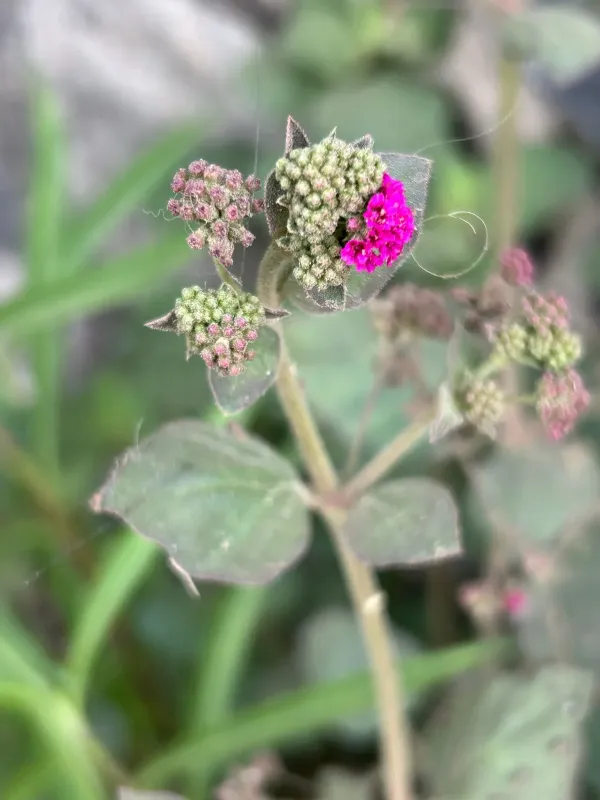
Boerhavia coccinea, commonly known as scarlet spiderling, is a perennial herb belonging to the Nyctaginaceae family.
The plant features spreading or ascending stems that can reach significant lengths, often forming dense mats across the soil surface.
Its leaves are opposite, ovate to elliptic in shape, often with wavy margins, typically ranging from 2 to 6 centimeters in length.
The flowers are arranged in umbel-like inflorescences; they are small, bright pink to purple, which gives the plant its descriptive common name.
The root system is robust and often thickened, allowing the plant to survive drought conditions and recover rapidly after mechanical disturbances.
Where it grows
This species prefers tropical and subtropical regions but is actively spreading as a weed across various climatic zones worldwide.
It is found in agricultural fields, along roadsides, on abandoned land, wasteland, and in gardens, where it quickly occupies available space.
It particularly damages commercial crops such as corn, cotton, peanuts, and soybeans by competing for moisture and essential nutrients.
The plant shows high adaptability to various soil types, including nutrient-poor and saline soils, making natural control challenging.
Its ability to propagate rapidly through vegetative growth and high seed production makes it a highly aggressive invasive species.
Harm it causes
The primary damage lies in intense competition with crop plants for water and mineral fertilizers during critical growth stages.
The creeping stems create a thick canopy that prevents soil warming and hinders the normal development of crop seedlings.
Boerhavia often acts as a reservoir for various viral and fungal diseases, which are subsequently transmitted to neighboring agricultural crops.
The presence of this weed in fields complicates mechanical operations, often causing clogging in harvesting equipment mechanisms.
Significant biomass accumulation by the weed depletes soil resources, reducing overall crop yield and product quality, leading to financial losses.
How to control
Mechanical control methods include regular deep plowing and cultivation, aimed at exhausting the nutrient reserves stored in the rootstock.
It is essential to conduct weeding during early developmental stages before the root system reaches deep soil horizons and gains sufficient energy.
Chemical control is performed using systemic, broad-spectrum herbicides applied during early vegetative phases or on post-harvest stubble.
Glyphosate-based products are effective, but strict application protocols must be followed to avoid damage to target agricultural crops.
- Implementing crop rotation with species that suppress weed growth.
- Using cover crops to limit light penetration to the weeds.
- Regular cleaning of field edges and borders to remove primary infestation sites.
Taxonomy
- Latin name
- Boerhavia coccinea
- Family
- Никтагиновые
- EPPO code
- BOECC