

Description
How to tell it apart
Loose silky-bent (scientific name: Apera spica-venti) is a winter annual grass weed belonging to the Poaceae family. It is widely considered a major threat to winter cereal production.
The plant typically grows as a loose tuft with stems reaching heights of 20 to 100 cm. The leaves are narrow, rough to the touch, and often possess a characteristic vibrant green color.
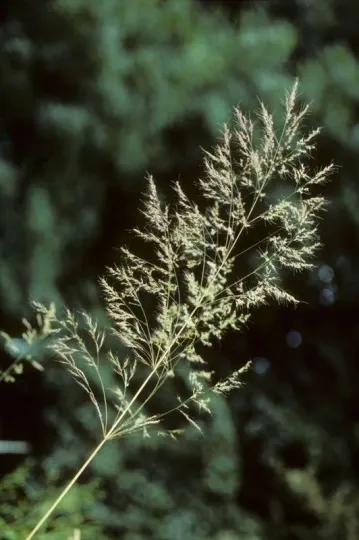
The inflorescence is a large, very diffuse panicle that takes on a silvery-purple hue during flowering. This distinctive appearance makes it relatively easy to identify in the field.
A single plant is capable of producing an enormous quantity of seeds, often ranging from 15,000 to 20,000, which are easily dispersed by wind and harvesting equipment.
The seeds have a high degree of longevity, allowing them to remain viable in the soil for several years and creating a persistent seed bank that challenges crop management.
Where it grows
This weed prefers moist, nutrient-rich soils, particularly those with a sandy or loamy texture. It is highly adapted to the environmental conditions common in temperate European agriculture.
The primary habitat for Apera spica-venti is winter-sown cereal crops, including winter wheat, rye, and triticale, where it thrives alongside the emerging crop plants.
It can also be found in non-crop areas such as field margins, roadsides, and abandoned lands, which serve as reservoirs for future infestation of adjacent agricultural fields.
The plant demonstrates excellent cold hardiness, allowing it to survive through the winter in the seedling stage and resume rapid growth immediately when spring temperatures rise.
Its ecological plasticity enables it to colonize fields quickly if crop rotation is insufficient or if the soil cultivation practices fail to suppress early weed emergence.
Harm it causes
Loose silky-bent competes aggressively with cereal crops for essential resources, including light, soil moisture, and nitrogen, significantly inhibiting crop growth in early spring.
High infestations of this weed can drastically reduce tiller density in wheat and rye crops, directly resulting in substantial yield losses that can reach significant economic levels.
As a host species, it can harbor various pests and diseases that affect cereals, thereby increasing the overall phytosanitary risk to the farm and the need for pesticide inputs.
The high density of the weed canopy can promote crop lodging, which complicates harvesting operations and leads to increased grain losses and higher labor costs during harvest.
Contamination of harvested grain with loose silky-bent seeds reduces the commercial value of the crop and necessitates additional cleaning procedures before processing or storage.
How to control
Integrated weed management is crucial for the control of Apera spica-venti, involving proper crop rotation and timely soil cultivation to disrupt the weed's life cycle.
Shallow tillage immediately after harvest (stubble cleaning) helps to encourage the germination of surface seeds, which can subsequently be destroyed by deeper primary cultivation.
Chemical control remains the most effective tool in modern agriculture, utilizing selective systemic herbicides applied during the early growth stages of the weed.
- Application of ALS-inhibiting herbicides or other effective modes of action.
- Correct timing of herbicide spraying to target weeds at the vulnerable vegetative stage.
- Rotational use of herbicide chemistries to mitigate the development of weed resistance.
Farmers should prioritize the use of weed-free certified seeds to prevent the introduction of this aggressive species into clean fields or newly established crop areas.
Content graph
Connections · Loose silky-bent
Most often together:
Marketplace
Products · 128


Pallas 45 OD
Ван Діст Сапплай Ко., Вебстер Сіті, Айовa, США
Herbicides
0
0
·
39
2 offers
36.52 €per 1 l
Buy

Fusilade Forte 150 EC c.e.
Сингента Лімітед, Хаддерсфільд,Великоб-ританія
Herbicides
0
0
·
37
7 offers
19.83 €per 1 l
Buy


Starra, CE (Hizalofop-P-ethyl, 50 g/l)
ДДЕ Фарм АГ, Тризен, Ліхтенштейн
Herbicides
0
0
·
36
1 offer
812.51 €per pack
Buy

Quin Star Max
ТОВ «Фабрика агрохімікатів», Черкаси, Україна
Herbicides
0
0
·
36
14 offers
7.38 €per 1 l
Buy


Zlakodin w.d.g.
Санрайз Кемікалз Ко. Лтд., Шанхай, Китай
Herbicides
0
0
·
34
3 offers
438.39 €per 1 l
Buy

MONITOR, WG, (Sulfosulfuron, 750 g/kg)
Монсанто Європа С.А., Антверпен, Бельгія
Herbicides
0
0
·
34
1 offer
247.07 €per pack
Buy


Darwin c.e., (clethodim, 120 g/l)
China Chemical Industrial & Rice Co. Ltd
Herbicides
0
0
·
33
2 offers
6.38 €per 1 l
Buy

KlotoDim, a.e., (KlotoDim, 240 g/l)
«Shenyang Sciencreat Chemicals Co., Ltd», Shenyang, Liaoning, Китай
Herbicides
0
0
·
33
2 offers
13.07 €per 1 l
Buy

Erru 120 g/L, herbicide
F.A.GAN Chemical Manufacturers Ltd. Israel, member
Herbicides
0
0
·
31
4 offers
3.14 €per 1 l
Buy

Centor, KE (clethodim, 240 g/l)
Jiangsu Fengshan Group Co., Ltd, Китай, Nanjing Fengshan Chemical Co., Ltd, Китай.
Herbicides
0
0
·
30
2 offers
9.36 €per 1 l
Buy


Blade, KE (clethodim, 120 g/l)
Hangzhou Ruijiang Chemical Co., Ltd.
Herbicides
0
0
·
29
7 offers
5.77 €per 1 l
Buy

Starba, KE (Hizalofop-P-ethyl, 50 g/l)
ДДЕ Фарм АГ, Тризен, Ліхтенштейн
Herbicides
0
0
·
29
1 offer
812.51 €per pack
Buy

Monitor, WG, herbicide
Sumitomo Chemical Agro Europe S.A.S.
Herbicides
0
0
·
29
4 offers
320.96 €per 1 l
Buy

Zlakodin, w.r.g. + PAR Poliamin (sulfosulfuron, 750 g/kg)
Санрайз Кемікалз Ко. Лтд., Шанхай, Китай
Herbicides
0
0
·
29
1 offer
7.17 €per pack
Buy

Norwel, CE (Hizalofop-P-ethyl, 50 g/l)
Jiangsu Agricoem Laboratory Co., Ltd.
Herbicides
0
0
·
27
3 offers
7.52 €per pack
Buy


CENTAUR K.E. HERBICIDE WITH SURFACTANT PLANTAGE
Jiang'an Agrin Company Ltd.
Herbicides
0
0
·
27
1 offer
10.26 €per 1 l
Buy


Gamma EC
Nanjing No.1 Pesticide Factory of Red Sun Group Co., Ltd.
Herbicides
0
0
·
1.1K
No offers
—
Details

Gramidin EC, KE
Jiangsu SevenContinent Green Chemical Co., Ltd.
Herbicides
0
0
·
127
No offers
—
Details


MONITOR, WG, (Sulfosulfuron, 750 g/kg)
Ван Діст Сапплай Ко., Вебстер Сіті, Айовa, США
Herbicides
0
0
·
60
No offers
—
Details

Zlakodin, w.d.g., (Sulfosulfuron, 750 g/kg)
Санрайз Кемікалз Ко. Лтд., Шанхай, Китай
Herbicides
0
0
·
60
No offers
—
Details


HERBICIDE «SELENIT», K.S., (KLETODIM 120 G/L)
«Нанджин Ессенс Файн-Кемікал Ко. Лтд» (Китай)
Herbicides
0
0
·
58
No offers
—
Details

Zlakodin, w.d.g., (Sulfosulfuron, 750 g/kg)
Санрайз Кемікалз Ко. Лтд., Шанхай, Китай
Herbicides
0
0
·
57
No offers
—
Details

Oreol c.e., Herbicide (Hizalophop-P-ethyl 50 g/l)
Unicity Enterprises L.P.
Herbicides
0
0
·
56
No offers
—
Details


Ric, CE, (Halexon-p-ethyl, 125 g/L)
Jiangsu Institute of Ecomones Co., Ltd.
Herbicides
0
0
·
45
No offers
—
Details


Tröl, EC, (ADG 1/14)
Три Дельта Компані Інтернешнл, Гонконг, Китай.
Herbicides
0
0
·
41
No offers
—
Details


Biology
Taxonomy
- Latin name
- Apera spica-venti
- Family
- Однолетние злаковые