
Vending Machine Business: Ideas, Locations, Equipment
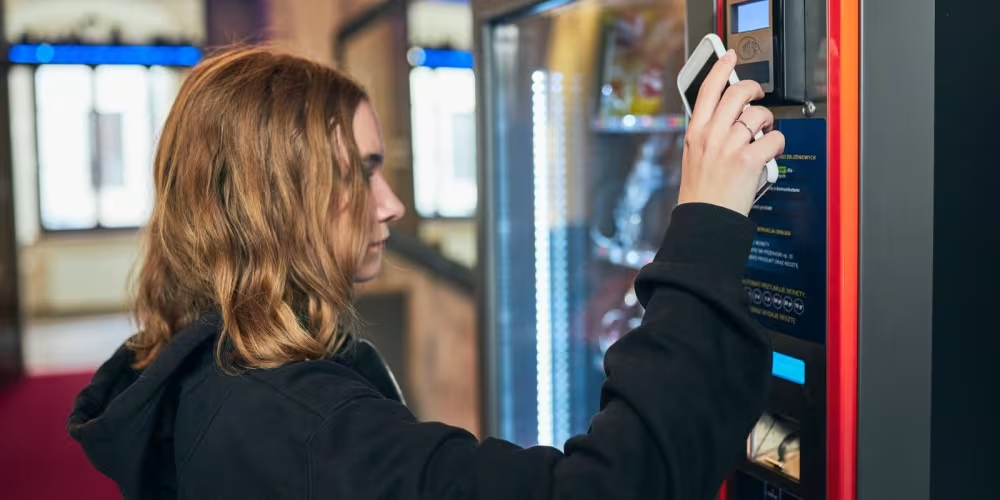
Vending is usually associated with coin-operated coffee in an office hallway, and because of this image, many consider the business outdated. In reality, both the machines and what is sold in them have changed.
Why Vending Machines Still Make Money
Vending is usually associated with coin-operated coffee in an office hallway, and because of this image, many consider the business outdated. In reality, both the machines and what is sold in them have changed. Modern machines accept smartphone payments, display products on large screens, support refrigeration, heating, and freezing, and allow owners to monitor sales directly from their smartphones. You can sell not only snacks, but also salads, desserts, farm eggs, vegetables, sushi, flowers, and e-commerce parcels.
The main reason the model works is that people want to buy something right now, and they don't care whether a salesperson is standing behind a counter. Nighttime, a holiday, a late flight, a weekend in a residential area where all the shops are closed. At these moments, a vending machine beats a traditional retail outlet simply by being open.
The second reason concerns the entrepreneur. Vending does not require renting a large space, a staff of cashiers, or a rigid schedule. Costs boil down to equipment, location space, merchandise, and maintenance. That is why this business attracts farmers who want to sell without intermediaries, cafes looking for an additional sales channel, and people without retail experience who need a managed setup with clear logic.
At the same time, vending only seems simple. The machine does not earn anything on its own: money is brought in by the right location, the right product selected for it, and regular maintenance. Below is what these three things consist of.
Types of Vending Machines
Classic beverage machines make coffee, tea, or dispense water and lemonade. They perform well where people wait or work for a long time: in offices, at train stations, and in educational institutions. The main challenge here is the hot water system: a machine with a coffee maker requires a water supply, regular washing, and careful maintenance.
Snack machines sell packaged goods with a long shelf life: bars, nuts, cookies, and chips. This is the easiest format to maintain because products do not spoil within a day, and you can restock them once a week or even less often. In exchange, the margin per unit of goods is small here, and success depends on foot traffic.
A separate group consists of machines with refrigerated compartments. They sell items that require temperature control: salads, ready meals, desserts, dairy products, and sushi. Each compartment opens only after payment, so portions do not mix, and products are not touched by other people's hands. Such a format yields a higher markup, but it also requires discipline regarding expiration dates.
There are machines for non-food items: hygiene products, umbrellas, charging cables, souvenirs, cosmetics, and small accessories. They are especially relevant where a person suddenly needs something and going to a store is inconvenient: at airports, hotels, on beaches, and in shopping centers.
Finally, service machines and pickup points. They do not dispense drinks or drop items; instead, they provide access to a locker: picking up an online store order, receiving hot food from a restaurant, dropping off or picking up an item. Vending machines based on automated lockers are built on these principles: the customer selects a product on a large touch screen, part of the order can be placed in the lockers by a courier, and it can be picked up at a convenient time. This is no longer just a product dispenser, but a full-fledged point of sale without a salesperson.
What to Sell Through a Vending Machine
The most interesting ideas arise when you have your own product, rather than just reselling someone else's. Then the machine becomes not a separate business, but a sales channel for an existing one.
Farm produce. Eggs, potatoes, carrots, onions, beets, fruit. The farm sets up a machine near its gates or at the edge of the village, and passing buyers pick up products at any time of day. Separate compartments with temperature and humidity control help products stay fresh longer, while transparent doors allow customers to inspect their purchase before paying. Prices are easy to adjust depending on the harvest.
Confectionery. Cakes and pastries from a small bakery that doesn't want to pay rent for a display case in a shopping mall. The machine is placed in a high-traffic location, and products are restocked once or twice a day. Holiday items work especially well: for birthdays, weekends, and New Year.
Healthy food. Salads, bowls, portioned meals. This is a niche where demand holds steady all day, and competition with fast food is weaker than it seems: people in business centers and near fitness clubs are looking for something to eat between tasks and are willing to pay for freshness. Establishments that make such food get another sales channel without needing a second administrator.
Sushi and rolls. A restaurant or small kitchen sells ready-made sets through a machine in a shopping mall or residential complex. Here, temperature control and tracking the shelf life of each batch are crucial: raw fish does not forgive negligence.
Pickup point for an online store. A store that delivers orders to a vending machine instead of a home saves on couriers and gives customers time flexibility. The same applies to a coffee shop that collects pre-orders: a person orders from their phone and picks it up without waiting in line.
Hot and heated goods. Croissants, bread, ready meals, mulled wine in winter. A machine that keeps food warm fits into the routine of someone going to work in the morning or returning late at night.
Emergency items. Umbrellas for rain, charging cables, hygiene products, small gifts. This is not about daily shopping, but situations where a client is willing to overpay for speed. They work best where people have no time to go to a store: airports, hotels, train stations, and resorts.
Where to Place a Vending Machine
Location dictates more than equipment brand. The exact same machine in one hallway sells daily, while in another it stands almost empty. The common feature of successful locations is high foot traffic, people lingering or waiting, and the absence of a convenient alternative nearby.
Office and business centers provide steady traffic on workdays but are empty on weekends. Shopping centers work in reverse: the peak happens right on weekends. Residential complexes are useful for everyday goods and fresh food because people return in the evening when stores are already closed. Educational institutions bring in many buyers during breaks, though they are price-sensitive. Train stations, airports, hotels, and resorts thrive on impulse purchases, where price takes a backseat.
A separate scenario applies to farmers and producers: the machine stands near the farm or along a highway where locals and passersby buy products.
You can test a location without financial investment. Spend a few days at the location at different times: count people, see what they carry from neighboring spots, and observe their behavior. If people leave a store with coffee, they will buy it from you too. If there is a line at a neighboring kiosk, the niche exists.
When negotiating with the property owner, find out if there will be access to an electrical outlet and internet, who is responsible for equipment security, whether you can place it permanently, and during what hours people are allowed to approach. Renting space for a machine usually costs much less than a full-fledged retail spot, but the terms should be put in writing: losing a location after a spot has gained traction is the most painful scenario in this business.
How to Calculate the Economics
A machine's return on investment depends on the location, assortment, price, maintenance quality, and regularity of restocking. There is no universal figure, and anyone who promises one in advance either doesn't know your location or is trying to sell you equipment. An honest calculation consists of several parts that are best calculated separately.
Part one: your initial investments. The machine, delivery, installation, setup, initial stock of goods, signage, or branding. Part two: monthly operating expenses. Location rent or a percentage to the property owner, electricity, internet, acquiring fees, write-offs of expired products, travel expenses to the machine, and labor costs if you aren't doing everything yourself. Part three: average daily sales, and here it is useful to plan for a cautious scenario rather than the best one.
The most common calculation mistake is failing to factor in write-offs. For dry snacks, this is minimal, but for salads, sushi, and cakes, it can eat up a significant portion of the margin if too much is stocked. Therefore, products with short shelf lives should be kept in limited quantities and restocked more frequently.
Screen advertising provides additional income. If the machine is located where people spend time, local businesses are eager to pay for ad displays. Promotions and surveys on the touch screen work the same way: they help sell more and gather customer insights.
Self-checks are simple. Write down how much each sale costs you, how much you earn from it after all monthly expenses, and how many such sales are needed per month for the spot to break even. If this number seems unrealistic for a specific location, it is better to change the location or product than to hope for a miracle.
What to Look for When Choosing Equipment
Start with the product, not the machine. First, determine exactly what you will sell, at what temperature it must be stored, and in what packaging, and then look for a machine suited to those conditions. Salads need cold, cakes need cold and calm without vibration, eggs need stable temperature and protection from breaking, vegetables need humidity, and bread needs warmth. There is no universal machine that handles everything equally well.
Next, check how well the machine maintains temperature. Individual compartments with their own climate control are more reliable than one large chamber because opening one door does not disrupt the cold in the entire machine. Doors must close tightly, and if the product is sold visually, a transparent front with insulated glass lets buyers see what they are paying for.
The payment unit must accept cards, smartphones, and, if your audience requires it, cash. A large touch screen is better: it can display ingredients, calorie counts, promotions, and videos. This helps sell rather than just dispense.
Assess the software side separately. Remote access to assortment, prices, inventory levels, and sales saves hours of driving. The system should alert you when stock is running low, a compartment fails to open, or power is lost. Program updates should not depend on the whims of third-party suppliers.
Also, ask about the manufacturer before purchasing rather than after the first breakdown: who will come, how quickly they will send spare parts, and whether they provide remote assistance. Companies that manufacture their own housings, electronics, and software solve problems faster because they don't shift responsibility onto someone else. You can browse a catalog of solutions for various retail and dispensing formats on the website mvk-mash.com: from storage lockers to machines for food, flowers, parcels, and charging stations.
Launch and Daily Operations
Your first machine should be viewed as an educational experiment rather than a money factory. Set it up, spend a few weeks observing, and only then decide whether to expand. During this time, it will become clear which items sell eagerly, during what hours peaks occur, and what remains on the shelves.
Core daily work consists of three things: purchasing, restocking, and monitoring. Purchasing is conveniently organized so that suppliers deliver goods pre-packaged or at least on a fixed day. Restocking is ideally combined with other errands: whoever drives past replenishes it. Monitoring is done via a smartphone, showing inventory levels, sales, and equipment status.
Cleaning and inspection are needed regularly. Wipe down the front and touch screen, check whether doors close properly, verify that lighting works, and ensure price tags are legible. A machine that looks neglected sells poorly: people are reluctant to trust food from a dirty machine.
Expiration dates require constant attention. Products with short shelf lives are best restocked in small portions, and expired items must be removed without exception. A single food poisoning incident will ruin a location's reputation beyond repair.
Complaints are also inevitable. A compartment didn't open, payment didn't go through, wrong item. The machine should display a phone number or messenger handle for support, and refund policies should be clearly posted. Quick responses turn frustrated buyers into regular customers.
Sales analysis over time teaches you more than any planning. If a certain product sells out first every time, increase its share. If an item sits for weeks, replace it. A machine regularly adapted to its buyers earns more than one that stands unchanged.
Common Mistakes
Buying a machine before choosing the product. Equipment unsuited for a product either has to be modified or the concept must change. Therefore, the sequence must be: idea, product, storage requirements, and only then the machine.
Placing it where convenient for the owner, not the buyer. A spot near your own office or a familiar store seems like a safe choice, but without foot traffic, it yields nothing. Foot traffic matters, not proximity to home.
Stocking too much and for too long. This is especially dangerous for food: what fails to sell in time turns into a loss. It is better to slightly understock than to throw things away.
Neglecting the machine's appearance. Dust, peeling stickers, a burned-out bulb, empty shelves make a spot look abandoned, and buyers simply walk past.
Ignoring data. The system shows what sells, when, and at what price, but some owners never open it for years. This is equivalent to owning a store and never looking at the cash register.
Forgetting the rules. Selling food is subject to sanitary requirements, and payment processing and receipt issuance are regulated by local laws that vary from country to country. Before launch, find out what permits and registrations you need and clarify this with local authorities or an accountant.
Expecting overnight wealth. Vending works like slow accumulation: a location reaches stable sales not in a day or a week, and the first months are spent tuning it. Entrepreneurs who enter with this understanding stay in business longer.
Little-Discussed Formats
Beyond food and beverages, there are niches where competition is still weak and the logic is identical: a machine replaces a salesperson where people are willing to pay for speed and convenience.
Flower vending machine. Bouquets are bought at unexpected times: on the way to a date, late at night, on a holiday when all flower shops are already closed. The flower machine keeps blooms in the cold, and customers choose bouquets on a screen and retrieve them from a compartment. Especially relevant near metro stations, restaurants, and residential complexes.
Dry cleaning and laundry drop-off point. Customers leave clothes in a locker and pick them up clean a few days later, without adjusting their schedule to a storefront's working hours. Businesses can open new locations without hiring a separate employee for each.
Refrigerated vending machine for ready-to-eat products. Here you can sell frozen items: ice cream, dumplings, meat, poultry. This niche interests farmers and small producers whose products require deep cooling and for whom bringing goods to a store or market is unprofitable.
Parcel locker. Receiving packages from a machine is more convenient than waiting for a courier at home or standing in line at a post office. For the owner of such a location, income comes from fees per disbursement rather than product sales.
Gadget charging station. A person with a dead phone is willing to pay to charge it and run errands while leaving the device secured in a locker. Train stations, shopping malls, cafes, and waiting areas work best.
Automated key boxes and towel cabinets. The former helps hotels, apartments, and car rentals hand over keys without face-to-face meetings, while the latter dispenses towels on beaches, in pools, and at fitness clubs. Both formats provide services that previously required staff presence.
Editorial team agronom.info
Materials are prepared by the portal's agronomists and editors. We use only trusted sources: Ukrainian agricultural universities, variety registries, open scientific publications.
Related articles
Not yet comments. Be the first!
Comments · 0