
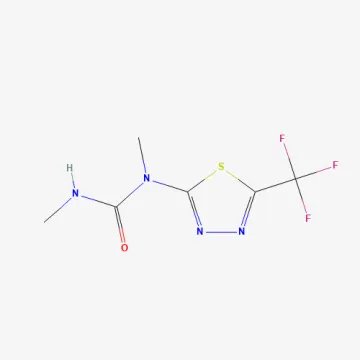
Thiazafluron
Description
Mode of action
Thidiazuron is a synthetic cytokinin-like compound that functions primarily as a plant growth regulator, although it exhibits significant herbicidal properties depending on the concentration and application method.
When used in lower doses, it acts by influencing plant development, particularly affecting leaf abscission and promoting shoot development in tissue cultures.
As an herbicide, it disrupts metabolic processes within plants, interfering with essential protein synthesis and leading to cellular stress and eventual plant tissue death.
The substance is typically absorbed through leaves and roots, moving systemically within the plant to exert its physiological effects on growth and development regulation.
Unlike standard herbicides that target photosynthesis directly, Thidiazuron works by inducing ethylene production and modulating hormonal balance, leading to systemic plant decay.
What it targets
Thidiazuron is widely recognized for its use as a defoliant, particularly in cotton production, to facilitate mechanical harvesting by removing leaves without damaging the crop.
It is also employed in plant tissue culture to promote the growth of buds and shoots, making it an essential tool in agricultural biotechnology and research laboratories.
In herbicidal applications, it is utilized to control various annual and perennial weeds on non-cropped areas, leveraging its potent systemic action.
The substance is effective against a broad range of broadleaf weeds that are otherwise difficult to manage with selective chemical treatments.
Its dual-purpose nature allows for specialized agricultural applications where both growth regulation and vegetative management are required simultaneously.
Rates and timing
Application rates for Thidiazuron are highly specific to the desired agricultural outcome, whether it be defoliation, growth promotion, or weed management.
For defoliation purposes, the timing is critical; applications must be made when the crop reaches physiological maturity to ensure effective leaf drop.
In tissue culture environments, concentrations are measured in milligrams per liter, requiring precise laboratory equipment to ensure optimal plant growth responses.
When applied as an herbicide, dosage must be calculated based on the density of the weed population and the environmental conditions of the treated area.
Frequent monitoring of treated areas is necessary to assess the effectiveness of the application and determine if subsequent treatments are required.
Restrictions
Thidiazuron must be handled with extreme care to avoid accidental exposure, as it is biologically active and can cause unintended growth effects on sensitive crops.
Environmental precautions are necessary to prevent the chemical from drifting into adjacent agricultural fields, water bodies, or non-target natural habitats.
Protective clothing, including chemical-resistant gloves and eye protection, is mandatory for operators to prevent absorption through the skin or inhalation.
Users must comply with local and international regulations regarding the usage, storage, and disposal of plant growth regulators and herbicidal chemicals.
The product should be stored in a cool, dry place away from direct sunlight to maintain chemical stability and prevent degradation over time.
Status in the European Union
Not approved in the EU
- CAS number
- 25366-23-8
- Category (EU)
- HB - Herbicide
EU status is for reference only and does not replace national registration in your country.