
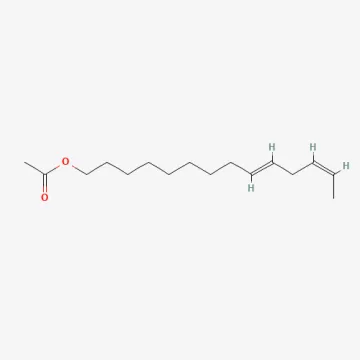
(Z,E)-9,12-Tetradecadien-1-yl acetate
Description
Mode of action
This compound belongs to the class of synthetic insect sex pheromones that mimic natural attractants produced by females of various Lepidoptera species. Chemically, it is an ester of an unsaturated fatty alcohol with high biological specificity.
The mechanism of action is based on the mating disruption technique. By deploying dispensers throughout the field, a constant pheromone background is created that overwhelms the natural signals released by females.
This disruption prevents males from locating females, thereby inhibiting the mating process and significantly reducing the reproductive potential of the pest population.
This method is a core component of Integrated Pest Management (IPM), drastically reducing the need for broad-spectrum insecticide sprays.
The substance is non-toxic to plants, beneficial insects, bees, and mammals, making it an environmentally friendly tool for sustainable agricultural practices.
What it targets
The substance is primarily used to control major Lepidopteran pests, particularly those belonging to the Gelechiidae family.
The primary target pest for this pheromone is the Tomato Leafminer (Tuta absoluta), a devastating pest of solanaceous crops worldwide.
It is widely applied in greenhouse and open-field vegetable production, including crops such as tomatoes, potatoes, and eggplants.
The effectiveness is due to the precise chemical structure which targets the specific mating signals of the intended pest species.
This approach is highly favored in organic farming where synthetic chemical residues on food products must be avoided.
Rates and timing
Application rates depend on the type of pheromone dispenser (e.g., polymer tubes, capillary vials) and the field size. A specific number of dispensers per hectare is required to ensure consistent coverage.
The timing of installation is determined by early-season monitoring using pheromone traps. Once the threshold level is reached, the disruption system must be deployed immediately.
Uniform placement of dispensers is critical for success, accounting for wind patterns and field geometry to avoid "hot spots" or gaps in the pheromone cloud.
The operational lifespan of a single dispenser typically ranges from 60 to 120 days, providing protection throughout the critical window of pest activity.
In cases of high pest pressure, it is recommended to combine mating disruption with biological control agents like parasitic wasps or microbial insecticides.
Restrictions
The main limitation is scale: mating disruption is most effective in large, contiguous areas, as fertile females can fly in from surrounding infested regions on smaller plots.
Extreme weather conditions such as prolonged heat or high wind speeds may increase the evaporation rate, reducing the effective duration of the dispensers.
Proper storage is essential; the product should be kept in a cool, dark environment (refrigerated) to maintain chemical integrity until it is needed for application.
The use of this pheromone for disruption makes it impossible to use standard pheromone traps for monitoring pest population density in the same area.
This is a preventive tool rather than a curative one; it does not kill existing larvae and cannot save a crop that is already severely infested.
Status in the European Union
Approved in the EU
- CAS number
- 31654-77-0
- Category (EU)
- AT - Attractant
- Approved from
- 01.09.2022
- Approval until
- 30.08.2037
- ADI
- Not appl.
- ARfD
- Not appl.
- AOEL
- Not appl.
EU status is for reference only and does not replace national registration in your country.