
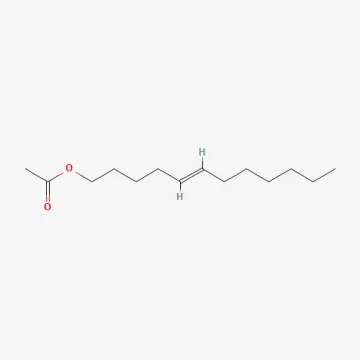
(Z)-5-Dodecen-1-yl acetate
Description
Mode of action
(Z)-5-Dodecen-1-yl acetate belongs to a group of synthetic insect sex pheromones. These compounds are designed to mimic natural chemical signals released by female insects to attract males of specific species for mating purposes.
The primary mechanism of action involves mating disruption. By flooding a target area with the synthetic pheromone, the male's ability to locate a female is significantly impaired. This interference reduces successful mating and lowers the pest population in subsequent generations.
In monitoring applications, the substance is used as a bait in specialized traps. It provides growers with real-time data on insect flight patterns, helping them to assess population density and timing of peak activity.
The selectivity of this substance is its major advantage, as it targets only the specific pest species, leaving beneficial predators, pollinators, and other non-target insects completely unaffected.
Technologically, these pheromones are delivered via controlled-release dispensers. These devices ensure a steady release of the active ingredient over several weeks, maintaining effective concentrations even under varying environmental conditions.
What it targets
The target range for (Z)-5-Dodecen-1-yl acetate primarily includes species within the Lepidoptera order, such as various types of moths that cause damage to orchards and vegetable crops.
It is specifically employed to control pests that have larvae causing significant economic damage to fruits, stems, or leaves. It serves as an essential tool in preventing the life cycle of these detrimental insects.
By using this pheromone, agronomists can effectively distinguish between different moth species in the field, allowing for a more tailored and precise approach to integrated pest management (IPM).
This biological control method is particularly valuable in organic farming, where conventional synthetic insecticides are limited or prohibited to preserve ecological balance.
Its use is also widespread in forestry and orchard management, where large-scale outbreaks need to be suppressed without resorting to heavy chemical interventions that harm the surrounding ecosystem.
Rates and timing
Application rates for pheromone traps and dispensers depend on the crop, the specific pest, and the desired strategy (monitoring vs. mating disruption). Typically, specific guidelines provided by the manufacturer ensure the correct spatial arrangement.
Timing is crucial. The deployment of dispensers or traps must coincide with the predicted emergence of the target insect generation to prevent the initial wave of egg-laying from occurring.
The lifespan of a single dispenser generally ranges from 4 to 8 weeks. Periodic replacement is necessary to maintain an effective plume of pheromones during the entire period of adult insect flight.
In mating disruption systems, the placement pattern of dispensers is critical for maximizing coverage. Uniform distribution across the field or orchard ensures there are no 'empty' spots that could allow pests to find each other.
Monitoring traps should be checked regularly to count the captured specimens, which serves as a benchmark for determining when to apply complementary pest control measures.
Restrictions
The most important limitation is the species-specific nature of the pheromone. It is essential to use the correct chemical isomer for the specific pest, as even a slight variation can render the product completely ineffective.
For mating disruption to be successful, large contiguous areas are usually required. In small or fragmented fields, the influx of mated females from surrounding untreated areas can undermine the effectiveness of the treatment.
Proper storage is vital; pheromones should be kept in cool, dark, and airtight conditions. Exposure to high temperatures or direct sunlight can lead to rapid chemical degradation and loss of biological activity.
Operators should wear gloves during the handling and installation of pheromone devices to prevent cross-contamination and to avoid the transfer of human odors, which can interfere with the attractant's efficacy.
Pheromones should be integrated into a comprehensive pest management strategy. Relying solely on pheromones without considering other factors like weather patterns or beneficial insect populations may not yield the best results.
Status in the European Union
Not approved in the EU
- Category (EU)
- AT - Attractant
EU status is for reference only and does not replace national registration in your country.