
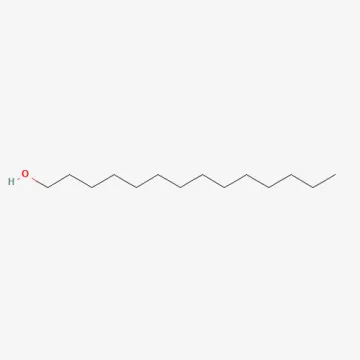
Tetradecan-1-ol
Description
Mode of action
Tetradecan-1-ol belongs to the chemical class of saturated primary fatty alcohols, widely recognized in agriculture as effective contact plant growth regulators. These substances serve as efficient management tools for plant architecture.
The mode of action is based on the disruption of cell membranes in tender plant tissues. Upon contact with the plant surface, the substance induces rapid dehydration and necrosis of the undifferentiated cells, specifically targeting meristematic tissues.
It acts exclusively through contact mechanisms and does not possess systemic mobility within the plant's vascular system. This selective action ensures that only the intended growth points are affected while the main plant structure remains unharmed.
Environmentally, the substance is highly biodegradable and does not persist in the soil or leave harmful residues in harvested plant products. This profile aligns with modern requirements for sustainable and eco-friendly farming practices.
Formulated typically as an emulsifiable concentrate, the substance forms a stable emulsion when mixed with water, which allows for uniform coverage on the target tissues during application.
What it targets
The primary use of tetradecan-1-ol is chemical sucker control in tobacco production. It effectively suppresses the growth of lateral buds and auxiliary shoots, ensuring that plant energy is directed into leaf development.
Beyond tobacco, this group of fatty alcohols acts as a contact desiccant for young weeds or unwanted plant parts in various horticultural and industrial crops, helping to manage crop density and spacing.
It provides an essential tool for integrated crop management, allowing growers to manipulate plant shape and development without the need for manual pruning or labor-intensive mechanical treatments.
The substance specifically targets actively dividing cells. It is not effective as a fungicide or insecticide and does not target mature plant organs, which makes it safe when applied according to specific crop-growth stage protocols.
By automating the control of lateral shoot development, this substance significantly increases operational efficiency and helps maintain the high quality of the final agricultural output.
Rates and timing
Application rates for tetradecan-1-ol are determined based on the crop growth stage and the density of suckers. Generally, water-based emulsions with active ingredient concentrations ranging from 2% to 5% are standard.
Precision in application is crucial. Because the product works through direct contact, the sprayer must ensure thorough coverage of the leaf axils where the target shoots are located for the treatment to be successful.
The timing of the application is usually synchronized with the plant's blooming period. Treatment should be performed before the lateral shoots become lignified or mature, as the product is most effective on young, succulent tissues.
Applications should be timed during periods of moderate temperature to prevent evaporation. Avoid spraying during high wind conditions to prevent drift, which could damage non-target areas of the crop.
Environmental conditions such as rainfall must be considered; if rain occurs shortly after application, the emulsion may be washed away, significantly reducing its efficacy and requiring a follow-up assessment.
Restrictions
Due to its high contact activity, improper application can cause phytotoxic burns to main leaves or the apical meristem, leading to potential yield losses if the sprayer calibration or technique is incorrect.
This substance is not a substitute for systemic disease or pest control products. Its regulatory functions are strictly limited to the control of growth processes and tissue necrosis in targeted areas.
Operators must wear appropriate personal protective equipment during handling. Although toxicity to mammals is low, direct contact with the concentrate can cause significant irritation to the eyes and skin.
Compatibility issues may arise when mixing with other chemicals. Always conduct a small-scale compatibility test to ensure that the emulsion stability is not compromised, which could render the treatment ineffective.
Storage must be handled in original packaging in a cool, shaded area. Excessive heat or prolonged exposure to direct sunlight can lead to product degradation and loss of chemical potency over time.
Status in the European Union
Approved in the EU
- CAS number
- 63393-82-8
- Category (EU)
- AT - Attractant
- Approved from
- 01.09.2022
- Approval until
- 30.08.2037
- ADI
- Not appl.
- ARfD
- Not appl.
- AOEL
- Not appl.
EU status is for reference only and does not replace national registration in your country.