
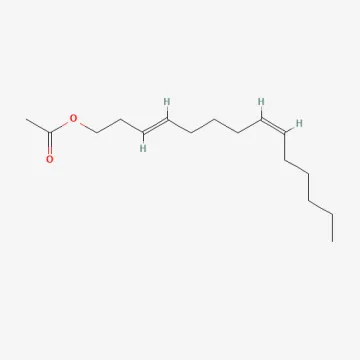
(E,Z)-3,8-Tetradecadien-1-yl acetate
Description
Mode of action
The substance belongs to the class of synthetic insect sex pheromones that mimic natural chemical signals released by females to attract males for mating.
The mode of action relies on creating a specific "pheromone cloud" that disrupts the ability of males to locate partners, effectively preventing mating.
Another primary application is the use of pheromone-baited traps, which serve as a critical diagnostic tool for early detection and population monitoring of lepidopteran pests.
Biological effectiveness is achieved by interrupting the reproductive cycle, leading to a natural and sustainable decline in pest population densities.
This class of compounds is considered environmentally friendly as it lacks direct toxicity towards beneficial insects, pollinators, or mammalian species.
What it targets
The primary target for this compound is the South American tomato pinworm (Tuta absoluta), a devastating pest of solanaceous crops.
The substance is also effective against various other moth species that share similar chemical communication pathways for mate finding.
Use is recommended for crops such as tomatoes, eggplants, and potatoes, both in open-field production and in protected greenhouse environments.
The target stage for the treatment is the adult moth, which allows for the disruption of the cycle before egg-laying occurs on foliage and fruits.
Feminine pheromone application is an essential component of Integrated Pest Management (IPM) programs, reducing the need for broad-spectrum insecticide sprays.
Rates and timing
For monitoring purposes, 1–2 traps per hectare are typically deployed, beginning at the start of the growing season or shortly before expected pest emergence.
For mating disruption (confusion) techniques, the required number of dispensers ranges from 500 to 1000 units per hectare, depending on pest pressure and field architecture.
Dispenser replacement intervals generally range from 4 to 8 weeks, depending on climatic conditions and the specific formulation's longevity.
Monitoring should begin during the seedling stage or immediately after transplanting to accurately capture the arrival of the first generation.
Even distribution of the dispensers throughout the field is crucial to maintain a consistent concentration level and prevent gaps in the pheromone plume.
Restrictions
Pheromone-based control is most effective at low to moderate population densities; under high-pressure outbreaks, it must be integrated with additional control measures.
Products require careful storage in airtight containers in cool, dark environments to prevent chemical degradation of the active ingredient.
Avoid touching dispensers with bare skin, as pheromone contamination on clothing or tools can cause cross-contamination and affect trap accuracy.
The method is most efficient when implemented on a landscape or field-wide scale; efficacy may diminish on very small or isolated plots.
Regular maintenance of traps, including clearing debris and counted pests, is necessary to ensure consistent performance and reliable data collection.
Status in the European Union
Approved in the EU
- Category (EU)
- AT - Attractant
- Approved from
- 01.09.2022
- Approval until
- 30.08.2037
EU status is for reference only and does not replace national registration in your country.