
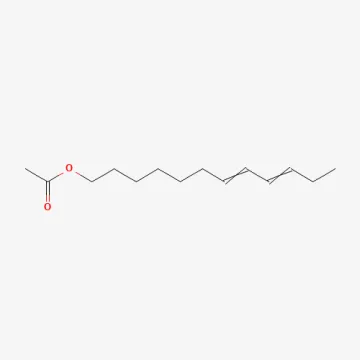
(E,E)-7,9-Dodecadien-1-yl acetate
Description
Mode of action
(E,E)-7,9-Dodecadien-1-yl acetate acts as a synthetic sex pheromone analog, specifically designed to manipulate the reproductive behavior of harmful lepidopteran insects. It does not kill the pests directly, but acts as a communication disruptor.
The primary mechanism, known as mating disruption, involves flooding the orchard environment with synthetic pheromone molecules. This creates a chemical background that masks the natural signals emitted by females to attract males.
When males are unable to follow the pheromone plumes produced by females, mating is prevented or significantly delayed. This results in a substantial decrease in egg-laying, which collapses the pest population over consecutive generations.
This compound is highly selective and environmentally benign. It does not harm beneficial insects, predators, or pollinators, making it an ideal choice for Integrated Pest Management (IPM) programs in fruit production.
In addition to disruption, the substance is widely used in monitoring traps. By counting the number of insects caught, farmers gain precise insights into pest emergence and population dynamics, allowing for data-driven decisions.
What it targets
The primary target is the codling moth (Cydia pomonella), one of the most destructive pests in pomaceous orchards. Without control, this moth can infest a large percentage of apples, pears, and walnuts.
It is specifically used in commercial fruit orchards where high-quality production and pesticide residue management are the top priorities. The pheromone ensures protection without impacting the food safety profile.
Rates and timing
The application rate is based on the dispenser density per hectare. Typically, several hundred dispensers are placed in a grid pattern throughout the orchard to ensure a consistent atmospheric concentration of the active ingredient.
Timing is critical. Dispensers must be installed before the first flight of the moths in early spring. Regular monitoring ensures that the protective barrier remains active through all critical periods of pest activity.
Restrictions
Mating disruption efficacy is limited by the size of the treated orchard. Small or fragmented plots are prone to immigration of already-mated females from neighboring untreated areas, which can compromise overall results.
In cases of extreme pest pressure, mating disruption should be integrated with other compatible control measures. Environmental factors, such as extreme heat or persistent high winds, can influence the evaporation rate of the pheromone.
Status in the European Union
Approved in the EU
- Category (EU)
- AT - Attractant
- Approved from
- 01.09.2022
- Approval until
- 30.08.2037
EU status is for reference only and does not replace national registration in your country.