
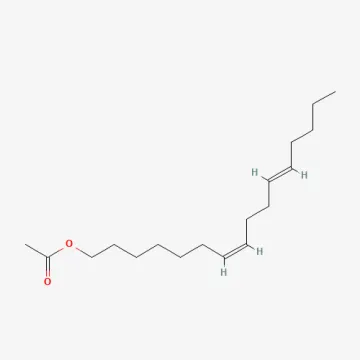
(Z,E)-7,11-Hexadecadien-1-yl acetate
Description
Mode of action
(Z,E)-7,11-hexadecadien-1-yl acetate is a synthetic sex pheromone analog designed to mimic the natural chemical signals emitted by female moths to attract mates. It acts as a behavioral modifier rather than a conventional insecticide.
The primary mechanism of action is mating disruption, where the air in the treated area is saturated with the pheromone, making it impossible for males to track the scent trail of females. This effectively stops reproduction within the treated field.
As a biological tool, it supports Integrated Pest Management (IPM) strategies by reducing the reliance on broad-spectrum pesticides, thereby preserving beneficial insect populations in the field.
The product is highly species-specific, ensuring that only target moth populations are affected, which makes it an ideal solution for modern sustainable farming practices.
The success of the method is dependent on environmental factors; volatile pheromones are susceptible to degradation by UV light, high temperatures, and excessive wind, requiring specific deployment strategies.
What it targets
This substance is primarily used to control various moth species within the Lepidoptera order, which are major economic pests in global agriculture.
It is specifically formulated to combat the cotton bollworm (Helicoverpa armigera), a highly destructive pest that affects a wide range of vegetable and industrial crops.
Beyond control, it serves as an essential component in monitoring systems, allowing growers to assess population density and the timing of emergence for subsequent control measures.
The compound is effective in diverse environments, including open-field agriculture, vegetable production, and high-value fruit orchards where pest pressure needs to be managed.
Regular application over wide areas helps to suppress local pest populations and prevent the significant crop damage associated with larval feeding.
Rates and timing
The timing of deployment is critical and should be synchronized with the early stages of moth flight, determined either by local monitoring traps or regional forecasting models.
Application rates vary based on the specific type of dispensers used and the target density required for effective mating disruption across the field plot.
In standard orchard setups, a density of 1 to 3 traps per hectare is typically used for monitoring, while mating disruption programs require significantly higher numbers of pheromone dispensers.
Dispensers must be replaced periodically, typically every 30 to 90 days, to ensure that the release rate remains within the threshold necessary to disrupt mating effectively.
It is recommended to begin placement before the first generation of the pest appears to ensure the entire breeding season is covered by the disruption program.
Restrictions
The substance must be stored in a cool, dark, and airtight environment to prevent the degradation of its chemical structure and to preserve its volatility.
Handling requires precautions to avoid cross-contamination; if the pheromone is accidentally transferred to clothing or equipment, it may inadvertently attract moths to non-target areas.
The efficacy can be compromised in areas with extremely high pest population densities or in cases where the treated field is adjacent to untreated, heavily infested sources.
Safety regulations advise keeping the product away from food storage areas and ensuring that the packaging remains intact during transportation and storage.
- Store at low temperatures to prevent premature evaporation.
- Ensure proper dispenser distribution to maintain a uniform pheromone cloud.
- Strictly follow the manufacturer's interval for dispenser replacement.
Status in the European Union
Approved in the EU
- Category (EU)
- AT - Attractant
- Approved from
- 01.09.2022
- Approval until
- 30.08.2037
EU status is for reference only and does not replace national registration in your country.