
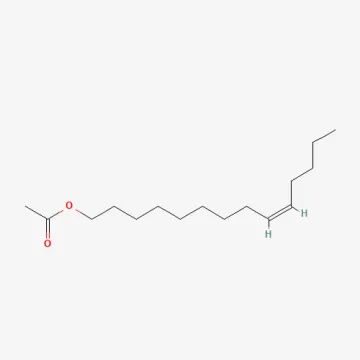
(Z)-9-Tetradecen-1-yl acetate
Description
Mode of action
(Z)-9-tetradecenyl acetate belongs to the class of synthetic insect sex pheromones widely used in integrated pest management (IPM) systems. Chemically, it is a volatile ester that mimics the natural scent released by female Lepidoptera insects to attract males for mating.
Its mechanism of action is based on creating a high concentration of pheromone background in the agro-ecosystem. Male pests, disoriented by the excess of signals, lose the ability to locate females, which leads to a dramatic decrease in population numbers in the subsequent generation.
Products based on this substance do not possess the classic toxic effects on insects like traditional insecticides. They work strictly by disrupting communication, making them environmentally safe for beneficial insects and pollinators.
Using this pheromone allows farmers to significantly reduce the frequency of chemical spray applications. It is an essential component of precision farming technologies aimed at reducing the pesticide load on crops and soil.
The substance is highly specific, so the choice of a particular pheromone formulation must strictly match the biological species of the pest present on the specific crop.
What it targets
(Z)-9-tetradecenyl acetate is a key component in controlling a wide range of Lepidoptera pests, particularly from the Tortricidae and Noctuidae families. It is used against fruit moths, leaf rollers, and other harmful butterflies that damage fruit and berry plantations.
Main target species include the winter moth, cabbage moth, and various types of fruit moths that cause significant economic damage to orchards and vegetable farms.
Monitoring systems using this pheromone allow agronomists to determine the start of pest flights and population peaks. This enables protective measures to be taken only when economic damage thresholds are reached.
Applying the product is most effective in large areas where a uniform "pheromone cloud" can be created. In small plots, the method's effectiveness may be lower due to the active influx of pests from neighboring territories.
The list of controlled objects also includes cryptic insect species whose detection by visual methods is difficult during the initial stages of population development.
Rates and timing
Application rates of (Z)-9-tetradecenyl acetate depend on the product's delivery system: it can be used as diffusers, dispensers, or impregnated polymer capsules. The standard scheme involves installing 300 to 500 dispensers per hectare of area.
The timing for installing pheromone protection must strictly coincide with the phenological phases of the insect's life cycle. Usually, this is the start of the overwintering generation's flight, determined by using control pheromone traps.
The effectiveness of the application is ensured by the continuous release of the active substance throughout the growing season. For maximum effect, it is important to ensure uniform distribution of the dispensers across the field.
The protective duration of a single dispenser is usually 60 to 120 days, depending on weather conditions and the evaporation rate of the active substance. After this period, components may need to be replaced.
When using traps for monitoring, glue liners should be changed as they become soiled or filled with insects to maintain the accuracy of population dynamic tracking.
Restrictions
The use of pheromone products requires strict temperature control during storage. In airtight packaging at low temperatures (usually in a refrigerator), the substance remains active for several years.
Special personal protective equipment is not required for personnel handling the product, as it is a natural analogue of the insect pheromone and is safe for humans when hygiene rules are followed.
A limitation is the high dependency of effectiveness on external climatic factors, such as strong winds or extreme heat, which can accelerate the evaporation of the active substance and disrupt the concentration of the pheromone cloud.
It is not recommended to combine pheromone disruption with frequent broad-spectrum insecticide sprays, as this may suppress beneficial entomofauna that naturally helps control pest populations.
The method is not intended for controlling pests in the larval or egg stage; therefore, in cases of high primary infestation, a combination of pheromones with other protection methods may be necessary.
Status in the European Union
Approved in the EU
- CAS number
- 16725-53-4
- Category (EU)
- AT - Attractant
- Approved from
- 01.09.2022
- Approval until
- 30.08.2037
EU status is for reference only and does not replace national registration in your country.