
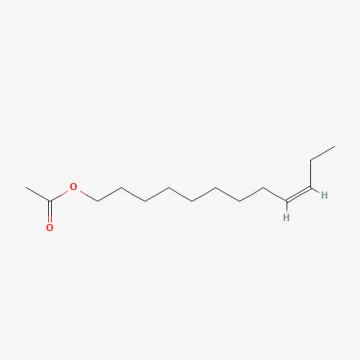
(Z)-9-Dodecen-1-yl acetate
Description
Mode of action
(Z)-9-Dodecenyl acetate belongs to the class of synthetic insect pheromones, specifically the group of sex attractants. Unlike traditional insecticides, it does not have direct toxic effects on the pest and does not kill it directly.
The main mechanism of action is the mating disruption technique. A synthetic analogue of the natural female sex pheromone creates a high concentration of the substance in the air, which makes it impossible for males to locate females for mating.
As a result of disrupting the search process, the reproductive cycle of the insects is interrupted. The pest population gradually declines due to the lack of fertilized eggs and a reduction in the number of the next generation.
Products based on this substance act specifically, affecting only the target insect species. This makes them an important tool in Integrated Pest Management (IPM) systems.
Using pheromones allows for a significant reduction in the number of applications of broad-spectrum chemical insecticides, helping to preserve beneficial entomofauna in agroecosystems.
What it targets
This substance is used to control a wide range of Lepidoptera, primarily from the Tortricidae family. It is a key component of pheromone traps and dispensers.
The main targets include dangerous pests such as:
- grape berry moth;
- turnip moth;
- various species of fruit moths;
- leafrollers damaging apple and pear orchards.
Due to its high specificity, the substance is effective even at low concentrations, allowing for population control in commercial orchards and vineyards.
Using this substance against the mentioned pests prevents damage to fruits, berries, and foliage, which directly impacts the commercial quality of the harvest.
Rates and timing
Application timing is determined based on pheromone monitoring data. Dispensers or traps are installed immediately before the mass flight of adult pests begins.
The application rate depends on the area and pest population density. On average, 300 to 500 dispensers per hectare of orchard or vineyard are required to ensure uniform distribution of the pheromone.
It is important to place the formulations in the upper part of the tree canopy, where insect flight is most active. Dispensers are replaced according to the manufacturer's instructions, usually once per season, due to the gradual evaporation of the substance.
Effectiveness is monitored by counting the number of individuals in control traps. If pest numbers exceed threshold values, additional protection measures may be required.
When planning activities, climatic conditions are taken into account, as high temperatures and strong winds can accelerate the evaporation of the active ingredient, reducing the lifespan of the dispenser.
Restrictions
The main limitation of use relates to the treatment area. Mating disruption is most effective in large areas (over 2–5 hectares), as in smaller areas, males may fly in from adjacent untreated plots.
Contact with open flames or strong oxidizing agents must be avoided. The product should be stored in a cool, dark place in airtight packaging to prevent degradation of the substance.
When working with pheromones, standard safety measures should be followed: use gloves to prevent the transfer of the scent to clothing or skin, as this can interfere with the operation of traps.
It is not recommended to combine mating disruption with broad-spectrum insecticide treatments, as the latter can destroy beneficial predators that complement the effect of pheromone usage.
No special measures for protecting bees or the environment are required, as (Z)-9-dodecenyl acetate is an environmentally safe compound with no systemic toxicity to warm-blooded animals.
Status in the European Union
Approved in the EU
- CAS number
- 16974-11-1
- Category (EU)
- AT - Attractant
- Approved from
- 01.09.2022
- Approval until
- 30.08.2037
EU status is for reference only and does not replace national registration in your country.