
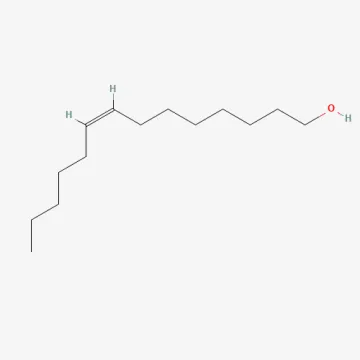
(Z)-8-Tetradecen-1-ol
Description
Mode of action
(Z)-8-Tetradecen-1-ol belongs to the class of synthetic sex pheromones. Chemically, it is an unsaturated fatty alcohol that mimics the natural chemical signals used by female moths to attract mates.
The substance functions as a species-specific attractant. When deployed in monitoring traps, it lures male moths into a collection device, allowing growers to quantify population levels accurately.
In mating disruption systems, the compound is released at high concentrations throughout the field. This overwhelms the male moths' sensory receptors, preventing them from locating real females.
By interfering with the mating cycle, this substance significantly reduces the number of fertile eggs laid on host plants, effectively lowering the pest population for the next generation.
As a biological-based tool, it provides an environmentally friendly alternative to broad-spectrum insecticides, as it does not harm beneficial insects like bees, predators, or parasitoids.
What it targets
This pheromone component is primarily targeted at various species of the order Lepidoptera, with a specific focus on the Tortricidae family and other fruit-infesting moths.
It is widely utilized in orchards and vineyards to manage pests that cause severe economic damage to fruits, shoots, and foliage by larvae feeding.
The substance is effective against several key agricultural pests, particularly the oriental fruit moth and various leafrollers, which are major threats in global fruit production.
Beyond monitoring, its use is essential for implementing Integrated Pest Management (IPM) strategies, enabling precise timing of control interventions.
- Monitoring seasonal moth flight patterns.
- Assessing pest density per hectare.
- Reducing chemical dependency through data-driven decisions.
Rates and timing
Dosage rates vary significantly depending on whether the substance is used for basic monitoring or for large-scale mating disruption programs in commercial orchards.
For monitoring, a standard pheromone lure containing a specific micro-dosage is placed in one trap every few hectares to provide a representative sample of the local moth population.
Mating disruption requires a much higher density of dispensers, typically applying 50 to 150 grams of the active ingredient per hectare to maintain a constant, effective odor plume.
Installation timing is critical and must align with the onset of the moth flight, usually determined by degree-day models to ensure the pheromone is present before the first peak emergence.
Regular maintenance is required, including the replacement of dispensers according to manufacturer guidelines to ensure the evaporation rate remains constant throughout the entire flight season.
Restrictions
Environmental conditions play a major role in the efficacy of (Z)-8-Tetradecen-1-ol. High wind speeds can rapidly dissipate the pheromone plume, reducing its ability to attract or disrupt moths.
Extreme temperatures can affect the volatile release rate of the chemical, potentially leading to faster depletion of the lure if exposed to intense, prolonged heat.
The substance is sensitive to oxidation and UV degradation; therefore, storage requires cold conditions and opaque packaging to preserve the chemical integrity of the pheromone.
Physical contamination of the dispenser or the trap environment can inhibit the release of the substance, necessitating routine inspections to ensure operational reliability.
Mating disruption using this pheromone should not be viewed as a standalone solution for severe infestations, as its efficacy decreases if the initial pest population density is excessively high.
Status in the European Union
Approved in the EU
- Category (EU)
- AT - Attractant
- Approved from
- 01.09.2022
- Approval until
- 30.08.2037
EU status is for reference only and does not replace national registration in your country.