
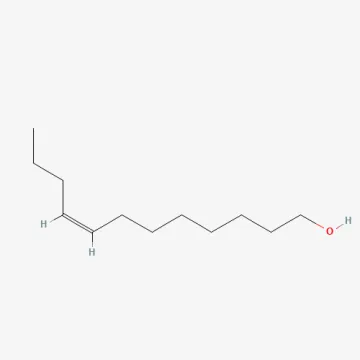
(Z)-8-Dodecen-1-ol
Description
Mode of action
This compound belongs to the class of synthetic insect sex pheromones, which mimic natural volatile attractants. The substance is not a traditional pesticide as it does not cause direct mortality of individuals, but operates on the principle of creating a "noise screen" within the tree canopy.
The mechanism of action is based on the mating disruption method: a high concentration of the substance in the air makes it impossible for males to detect the natural pheromone trail emitted by females. Consequently, the mating process is blocked, and the population size of the next generation is drastically reduced.
The use of pheromones is a key element of Integrated Pest Management (IPM) systems. It allows for a significant reduction in the use of highly toxic, broad-spectrum insecticides.
The product is highly selective and affects only target insect species, leaving beneficial entomofauna (predatory mites, parasitic wasps) unharmed.
The substance is characterized by high volatility, which ensures a uniform distribution of pheromone molecules in the ground-level atmosphere when dispensers are placed correctly.
What it targets
The main application of (Z)-8-Dodecen-1-ol is the control of lepidopteran pests from the Tortricidae family.
The substance has become most widely used in the control of the Oriental fruit moth (*Grapholita molesta*), which damages pome and stone fruit crops.
The compound is also effectively used against the plum fruit moth and several other species of small moths whose larvae develop inside fruits or young shoots.
The objects of protection are commercial orchards, vineyards, and berry fields, where the use of chemical pesticides is complicated by the harvest period.
The application of the product helps to reduce fruit damage from "worminess" and prevents the development of secondary infections that enter through pest-damaged areas.
Rates and timing
Application rates depend on tree planting density and the target pest species, typically requiring from 200 to 500 dispensers per hectare of orchard.
Dispensers should be installed well in advance of the first generation's peak flight, usually during or immediately after the flowering period.
For maximum effectiveness, dispensers are placed in the upper third of the tree canopy, where the pheromone concentration remains most stable.
The duration of a single set of dispensers is between 90 and 150 days, which generally covers the entire vegetation season and the active flight period of several pest generations.
A crucial requirement is to ensure the integrity of the dispensers and their uniform distribution across the entire orchard area, including the edges, to prevent migration of pests from outside.
Restrictions
The main limitation of this method is its dependence on the size of the isolated area; in small orchards (less than 1–2 hectares), the effect is reduced due to mated females flying in from neighboring territories.
In cases of extremely high pest density, the mating disruption method may require additional adjustment through localized insecticide treatments.
Safety precautions include wearing gloves during the installation of dispensers to avoid transferring odors to other objects and to preserve the integrity of the pheromone composition.
Unused dispensers must be stored in airtight containers in a cool place, protected from direct sunlight, to prevent the degradation of the active ingredient.
The use of pheromones does not require special respiratory protection, although general hygiene rules should be followed when handling any agrochemicals.
Status in the European Union
Approved in the EU
- CAS number
- 40642-40-8
- Category (EU)
- AT - Attractant
- Approved from
- 01.09.2022
- Approval until
- 30.08.2037
EU status is for reference only and does not replace national registration in your country.