

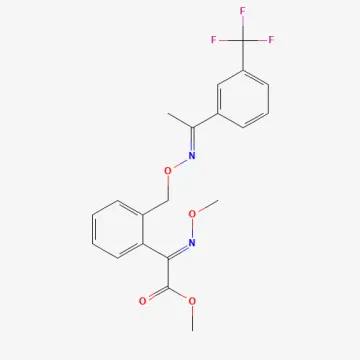
Description
Mode of action
Trifloxystrobin belongs to the strobilurin chemical class. It is a fungicide with a pronounced mesostemic mode of action, providing reliable crop protection against a wide spectrum of pathogens.
The primary principle of the substance is the inhibition of mitochondrial respiration in fungal cells. By blocking electron transport in the cytochrome b-c1 complex, trifloxystrobin effectively halts energy production in the pathogen's cells.
The substance has the ability to redistribute on the leaf surface through the formation of a vapor phase and adsorption into the waxy layer. This allows trifloxystrobin to work effectively even in zones not directly reached by the spray solution.
The product shows high activity at early stages of infection, preventing spore germination and mycelium development. It does not cause immediate spore death, but makes the fungus's development process impossible, which effectively suppresses the disease.
Due to its high lipophilicity, the active ingredient adheres firmly to the plant surface and exhibits excellent resistance to rain-washing shortly after application.
What it targets
Trifloxystrobin is used to control diseases caused by fungi from the classes Ascomycetes, Basidiomycetes, Deuteromycetes, and Oomycetes. It is effective against powdery mildew, leaf spots, rust, and scab.
This fungicide is most commonly used on the following crops:
- Cereal grains
- Vineyards
- Fruit trees (apples, pears)
- Vegetable crops
- Sugar beets
It successfully controls pathogens of septoria, rhynchosporium, and pyrenophora. The fungicide is also an indispensable tool for fighting oidium in vineyards.
In orchards, trifloxystrobin is applied against scab and moniliosis. It is often a component of combination products, which helps expand the range of protected crops and targeted objects.
Regular use of the product helps maintain high crop health, which is critical for realizing the genetic yield potential of agricultural crops.
Rates and timing
Application rates depend on the specific product, crop growth stage, and infection pressure. Typically, dosages in the range of 0.1–0.5 kg/ha (or L/ha) of the commercial product are used.
Spraying is carried out during the growing season at the first signs of disease. To achieve maximum effect, it is important to ensure uniform coverage of the leaf surface with the working solution.
The interval between treatments is usually 10–14 days, depending on weather conditions and the rate of leaf mass development. In protection programs, rotation with fungicides from other chemical classes is often recommended.
When used in mixtures, trifloxystrobin combines well with systemic fungicides having a different mechanism of action, which prevents the development of pathogen resistance.
It is important to follow the regulations specified on the specific pesticide label, as the concentration of the active ingredient in commercial products can vary significantly.
Restrictions
Trifloxystrobin is a moderately hazardous compound for warm-blooded animals. Standard personal protective equipment such as respirators, gloves, and protective clothing must be used when handling it.
The active ingredient is toxic to aquatic organisms. It is strictly prohibited for the product to enter water bodies, fish ponds, or drainage systems.
To prevent the formation of pathogen resistance, it is not recommended to conduct more than two treatments with strobilurin-group products per season on the same field.
The product should be stored in a cool, dry place, out of the reach of children and animals, and away from food and animal feed.
When disposing of containers and product residues, strictly adhere to environmental standards and existing legislation regarding pesticide waste management.
Content graph
Connections · Trifloxystrobin
Most often together:
Marketplace


