
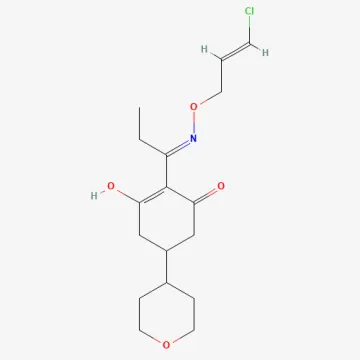
Tepraloxydim
Description
Mode of action
Tepraloxydim is a systemic herbicide belonging to the cyclohexanedione chemical class. It is widely recognized for its high efficiency in controlling various grass weeds in agricultural settings.
The primary mechanism of action is the inhibition of the enzyme acetyl-CoA carboxylase (ACCase). By blocking this enzyme, the compound effectively disrupts lipid biosynthesis, which is vital for the growth and development of plant cell membranes.
Once absorbed through the leaves, the active ingredient translocates through the phloem to the meristematic tissues. This leads to the cessation of growth, chlorosis, and eventual death of the weed species.
Tepraloxydim demonstrates excellent selectivity, allowing it to be used on dicotyledonous crops such as soybeans, sugar beets, and sunflowers without causing phytotoxicity to the target crop.
The substance exhibits good rainfastness, with optimal absorption occurring shortly after application, ensuring consistent efficacy under varying environmental conditions.
What it targets
The primary target of this active ingredient is a wide spectrum of annual and perennial grass weeds. It is particularly effective against both seed-propagated grasses and rhizomatous species.
It provides reliable control over stubborn weeds like quackgrass, barnyardgrass, foxtail, wild oats, and blackgrass. These weeds often compete heavily with crops for sunlight, water, and nutrients.
By controlling these weeds during the critical stages of crop development, the herbicide helps maintain the yield potential of the field, preventing significant losses caused by weed interference.
Its systemic nature allows it to destroy the underground reproductive parts of perennial grasses, which provides long-term control rather than just surface foliage burn-down.
- Quackgrass (Elymus repens)
- Barnyardgrass (Echinochloa crus-galli)
- Foxtail species (Setaria spp.)
- Wild oats (Avena fatua)
- Blackgrass (Alopecurus myosuroides)
Rates and timing
The timing of application is critical for success. It is recommended to apply the herbicide during the active growth phase of weeds, typically between the 2-leaf stage and the early tillering stage.
Application rates depend significantly on the density of the infestation and the specific weed species present. Higher doses are generally required when dealing with dense patches of perennial weeds.
Soil moisture levels play a role in efficacy. Optimal results are achieved when weeds are not under water stress, as this allows for faster uptake and translocation of the active substance within the plants.
Tank mixing with other herbicides is possible to broaden the spectrum of controlled weeds, provided that compatibility tests are performed prior to mixing in the sprayer tank.
Mechanical operations like cultivation should be avoided shortly before or after application to ensure that the herbicide is not interrupted during its movement through the plant system.
Restrictions
Personnel handling products containing tepraloxydim must strictly adhere to safety protocols, including the use of appropriate personal protective equipment (PPE) such as gloves, goggles, and respiratory protection.
Drift management is essential. Care must be taken to prevent the spray from reaching adjacent cereal crops, which are extremely sensitive to cyclohexanedione herbicides and can be damaged by accidental exposure.
Environmental precautions must be taken to prevent contamination of water bodies, streams, or drinking water sources. All applications should follow local regulations regarding buffer zones.
To mitigate the risk of weed resistance, it is advised to rotate the use of tepraloxydim with herbicides possessing different modes of action within an integrated weed management program.
Storage should be conducted in original containers within dry, ventilated facilities away from direct sunlight and extreme temperatures to maintain the chemical integrity of the product.
Status in the European Union
Not approved in the EU
- CAS number
- 149979-41-9
- Category (EU)
- HB - Herbicide
- Approved from
- 01.06.2005
- Approval until
- 31.05.2015
- ADI
- 0.025 mg/kg bw/day
- ARfD
- 0.4 mg/kg bw
- AOEL
- 0.06 mg/kg bw/day
EU status is for reference only and does not replace national registration in your country.