
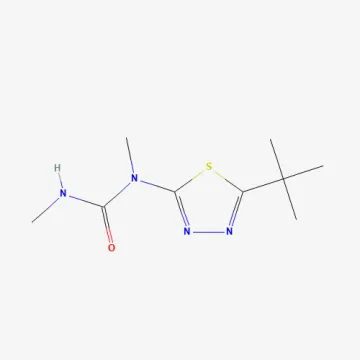
Tebuthiuron
Description
Mode of action
Tebuthiuron is a systemic herbicide belonging to the urea chemical class, characterized by its primary action through the soil and root absorption.
Upon absorption by the root system, the active ingredient is translocated through the xylem to the foliage of target plants.
The primary mechanism of action involves the inhibition of photosynthesis by blocking the electron transport system within the plant's chloroplasts.
As a result, treated plants undergo progressive chlorosis, necrosis, and eventual death due to the total interruption of their metabolic processes.
Due to its high soil mobility and persistence, tebuthiuron provides long-term residual control, preventing the emergence of new weeds for extended periods.
What it targets
Tebuthiuron is primarily employed for the management of broadleaf weeds, grasses, and woody plant species in various settings.
It is a staple herbicide in sugarcane cultivation, offering selective control without hindering the growth of the crop itself.
In range management and forestry, it is highly effective at thinning or removing undesirable brush and invasive trees to restore pasture productivity.
The compound is also widely used in industrial site management to keep utility rights-of-way, railways, and fencelines free of deep-rooted vegetation.
Its wide spectrum of activity makes it an essential tool for clearing land that is intended for long-term vegetation maintenance.
Rates and timing
Application rates for tebuthiuron must be carefully calibrated based on soil texture, organic matter content, and the specific target species.
Soils with higher clay and organic content generally require higher application rates to achieve the desired control compared to sandy soils.
Timing is crucial; application is typically recommended during the active growing season or just before expected precipitation to move the herbicide into the root zone.
Granular formulations are often used for spot-treatment of individual shrubs or trees, while broadcast applications are used for large-scale weed management.
Agronomists must verify that the amount applied does not exceed local regulatory limits to prevent off-target environmental damage.
Restrictions
The most significant limitation of tebuthiuron is its persistence in soil, which can restrict future crop rotations for several years.
Extreme care must be taken to prevent leaching into groundwater, especially in areas with sandy soils and high water tables.
Personal protective equipment (PPE) is mandatory during handling, as the chemical can cause irritation and systemic effects if not managed correctly.
Runoff must be prevented, as the product is highly toxic to non-target vegetation, trees in adjacent fields, and aquatic organisms in nearby streams.
Buffer zones should always be maintained between the application area and sensitive environments to prevent environmental contamination.
Status in the European Union
Not approved in the EU
- CAS number
- 34014-18-1
- Category (EU)
- HB - Herbicide
EU status is for reference only and does not replace national registration in your country.