
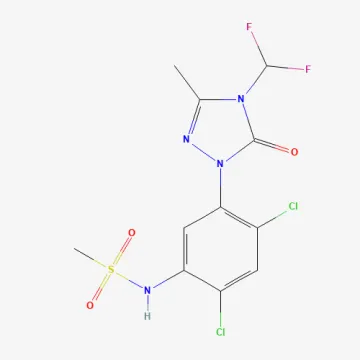
Sulfentrazone
Description
Mode of action
Sulfentrazone belongs to the aryl triazolinone chemical class. It is a highly effective herbicide primarily used as a pre-emergence soil-applied treatment, although it also exhibits contact activity when applied to emerged vegetation.
The primary mode of action involves the inhibition of the protoporphyrinogen oxidase (PPO) enzyme, which is critical for chlorophyll biosynthesis in plants. The disruption of this enzyme leads to the accumulation of intermediates that cause cellular membrane destruction upon exposure to sunlight.
As a result of this impact, weeds experience rapid wilting, chlorosis, and subsequent tissue necrosis. The process of weed elimination is swift, as the herbicide acts immediately upon the emergence of weed seedlings through the treated soil layer.
The substance is absorbed by both the roots and shoots of weeds. Due to its systemic movement within the plant, it provides reliable crop protection during the critical early growth stage when competition from weeds is most intense.
The high selectivity of sulfentrazone is due to the ability of cultivated crops (such as soybeans) to metabolize the active ingredient, neutralizing it before it causes damage to plant tissues.
What it targets
Sulfentrazone is designed to control a broad spectrum of annual broadleaf weeds. It shows high efficacy against hard-to-control species, including those that have developed resistance to other herbicide classes, such as ALS inhibitors.
The primary targets for the product include species such as common lambsquarters, amaranth species, common ragweed, black nightshade, morningglory, and velvetleaf.
The efficacy of the product depends directly on soil moisture. Adequate soil moisture is necessary to activate the herbicidal barrier and ensure full weed control.
The product is used primarily on crops such as soybeans, sunflowers, chickpeas, and corn. Depending on the region and usage regulations, it can be applied as a standalone treatment or as part of tank mixes.
- Amaranthus retroflexus
- Ambrosia artemisiifolia
- Chenopodium album
- Abutilon theophrasti
- Solanum nigrum
Rates and timing
Sulfentrazone application rates vary based on soil type, humus content, and the weed spectrum present in the field. On light soils with low organic matter, rates are usually reduced, whereas heavy clay or chernozem soils require higher rates for effective control.
Typically, the product is applied pre-planting or immediately after planting, but before crop emergence. Quality soil preparation is essential to ensure the herbicidal barrier is uniform across the entire field.
Application timing is strictly regulated: late application after crop emergence can lead to phytotoxicity and reduced yields. Therefore, agronomists recommend aligning the application with field readiness for planting.
When using tank mixes, it is critical to verify the compatibility of sulfentrazone with other products. It is frequently combined with clomazone or imazethapyr-based herbicides to broaden the spectrum of action.
Agronomists should carefully calculate the dosage, taking into account the risk of residual activity on subsequent crops in the rotation. In very arid regions, the degradation time of the substance may increase.
Restrictions
Sulfentrazone requires strict adherence to safety protocols during handling. Like many herbicides, it may cause skin and mucosal irritation, making the use of personal protective equipment mandatory.
Crop rotation restrictions are a critical factor. After using sulfentrazone, care should be taken when selecting succeeding crops, as residual amounts in the soil can affect the growth of sensitive species in the following season.
Application is not recommended on soils with very high sand content, as the risk of the active ingredient leaching into the crop's root zone increases, which may lead to crop damage.
Temperature during application is not a limiting factor, but excessive soil saturation immediately after treatment can lead to uneven distribution of the herbicide and reduced efficacy of the protective barrier.
Storage of the product should be in closed warehouse facilities, protected from moisture and direct sunlight, at temperatures that prevent the degradation of the active ingredient within the formulated product.
Status in the European Union
Not approved in the EU
- CAS number
- 122836-35-5
- Category (EU)
- HB - Herbicide
EU status is for reference only and does not replace national registration in your country.