
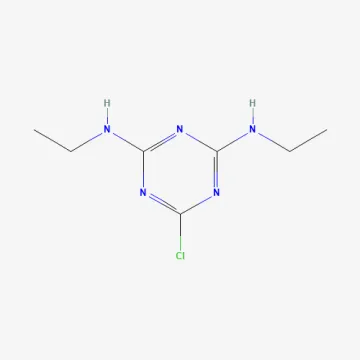
Simazine
Description
Mode of action
Simazine belongs to the chlorotriazine chemical class and acts as a systemic, selective herbicide. The molecules are absorbed primarily through the root system, classifying it as a soil-applied herbicide designed to suppress weed seedlings.
The biological mechanism of action is based on the inhibition of photosynthesis. Upon entering the chloroplasts, simazine blocks electron transport in photosystem II, which disrupts the energy metabolism within the weed cells.
As a result of halted photosynthetic activity, weeds stop absorbing carbon dioxide, leading to the rapid depletion of internal nutrient reserves. Shortly after application, chlorosis, wilting, and subsequent death of the target plants occur.
The efficacy of the preparation depends directly on soil moisture, as the substance requires dissolution to be absorbed by roots. On dry soils, the herbicidal effect may be significantly reduced or delayed.
The product exhibits high soil persistence, allowing it to maintain a protective screen for an extended period, preventing new flushes of weeds throughout the crop's growing season.
What it targets
Simazine is used to control a wide range of annual broad-leaved and some grassy weeds during their germination period. The substance is effective against species such as pigweed, common lambsquarters, knotweed, shepherd's purse, and other typical field weeds.
The primary use of this herbicide is for protecting perennial plantations, including orchards, vineyards, and berry fields, as well as specific industrial crops with deep root systems capable of tolerating triazine exposure.
Due to its high selectivity, crop plants with well-developed root systems are able to neutralize simazine by converting it into a non-toxic form, while weeds with shallow roots perish.
In agricultural practice, simazine is used to ensure clean inter-row spaces in orchards, where mechanical cultivation is difficult or may cause damage to tree roots.
- Amaranthus retroflexus
- Chenopodium album
- Polygonum aviculare
- Capsella bursa-pastoris
- Stellaria media
Rates and timing
Application rates are determined by soil type and mechanical composition. In light soils with low organic matter, minimal dosages are applied to avoid phytotoxicity to the crops.
In heavy soils rich in organic matter, the dosage must be increased because part of the active ingredient is adsorbed by soil colloids, reducing the concentration of simazine in the soil solution.
Optimal application timing occurs in early spring before sowing or immediately after planting, provided the soil has sufficient moisture levels to facilitate the dissolution of the granules or concentrate.
When used in orchards, application is conducted before weed emergence or at the very earliest stages of weed development, ensuring uniform distribution of the herbicide across the soil surface.
Exceeding recommended dosages is strictly prohibited, as simazine has the property of accumulating in the soil layer, which can negatively affect crops planted in the rotation in subsequent years.
Restrictions
The primary limitation when using simazine is its high persistence in the soil. Failure to follow regulations may lead to the accumulation of residual amounts, making it impossible to grow sensitive crops in the rotation for 1–2 years.
It is not recommended to apply the product on very light sandy soils with low organic content, where there is a high risk of the active ingredient leaching into groundwater or damaging crop plants.
Personal protective equipment for skin and respiratory protection is mandatory when working with simazine, as the substance can cause irritation and possesses certain toxicity to warm-blooded organisms.
Drift of the working solution to neighboring fields containing herbicide-sensitive crops must be avoided, as even small concentrations can cause growth suppression and significant yield loss.
After work is completed, spraying equipment must be thoroughly cleaned, as simazine residues can damage other crops during subsequent use of the equipment for applying fungicides or insecticides.
Status in the European Union
Not approved in the EU
- CAS number
- 122-34-9
- Category (EU)
- HB - Herbicide
EU status is for reference only and does not replace national registration in your country.