
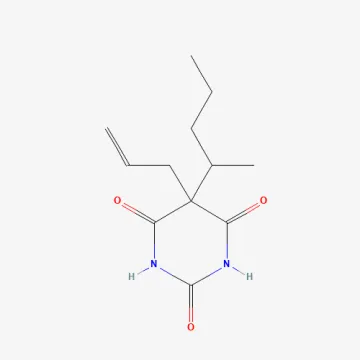
Secobarbital
Description
Mode of action
Secobarbital belongs to the barbituric acid derivative class. In agricultural and biological research, it acts as a specialized active substance designed to influence metabolic and neurological processes in specific target organisms.
The mechanism of action involves the modulation of neural pathways, which is utilized in highly controlled environments to study the biological responses and behavior of pests under laboratory conditions.
It is not categorized as a standard broad-spectrum herbicide, fungicide, or insecticide. Its use is limited to experimental agricultural science where precise physiological control is required.
The chemical structure allows for efficient absorption within target systems, making it a powerful tool for academic and research purposes rather than commercial field applications.
Efficacy is highly dependent on the precision of application protocols and the environmental stability of the chemical during the research phase.
Restrictions
Due to its significant biological activity on mammals, secobarbital use is strictly restricted. Safety protocols are mandated to prevent any accidental exposure during handling.
The substance is not suitable for open-field agricultural use, as it presents unacceptable risks to non-target wildlife and the broader ecological environment.
Storage of this compound requires high-security facilities, as it is classified as a controlled substance with specific regulatory oversight in most jurisdictions.
Personnel involved in the handling of secobarbital must strictly adhere to the use of professional protective equipment to avoid inhalation or dermal contact.
Disposal must be managed through specialized hazardous waste procedures, ensuring that no traces of the chemical enter soil or water ecosystems.
Status in the European Union
Not approved in the EU
- CAS number
- See note
- Category (EU)
- OT - Other treatment
EU status is for reference only and does not replace national registration in your country.