
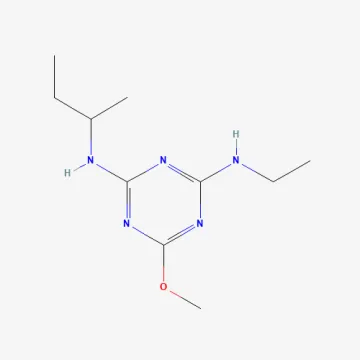
Secbumeton
Description
Mode of action
Secumetone belongs to the sym-triazine chemical class. It is a systemic herbicide that is absorbed by the plant root system from the soil solution after application.
The primary mechanism of action involves inhibiting photosynthesis in susceptible plants. The active ingredient blocks electron transport in photosystem II, leading to the cessation of organic compound production.
As a result of metabolic disruption in weeds, growth ceases, followed by gradual wilting and total death.
The effectiveness of the preparation depends directly on soil moisture, as the substance penetrates weeds primarily through the soil profile.
To ensure high selectivity, it is crucial to follow application regulations, as crop tolerance to secumetone is based on the plant's ability to metabolize the substance into non-toxic compounds.
What it targets
The preparation is designed to eliminate a wide range of annual broad-leaved and some grassy weeds.
It is effective against weed species such as Amaranthus, Chenopodium album, Polygonum, Galeopsis, and Stellaria media.
It is mainly used on crops exhibiting high tolerance to triazine derivatives, allowing for application during pre-emergence or early post-emergence periods.
The substance successfully suppresses weeds germinating from seeds in the topsoil layer, creating a protective "screen" effect.
The suppression spectrum covers both ephemeral weeds and more competitive species, ensuring crop purity during critical growth stages.
Rates and timing
Secumetone application rates vary depending on soil type: doses are reduced on light soils with low humus content and increased on heavy loams.
Application is recommended immediately before sowing with incorporation into the soil or directly after sowing before crop emergence.
A vital condition for effectiveness is careful soil preparation: the surface should be leveled, without large clods, ensuring uniform herbicide distribution.
Application in arid conditions requires mandatory mechanical soil incorporation to minimize active ingredient loss due to photodegradation.
- Optimal soil moisture is the primary success factor.
- Temperature conditions should not be extreme.
- High-quality sprayer calibration is necessary for uniform coverage.
Restrictions
The use of secumetone requires strict crop rotation adherence, as residual triazine levels in the soil may inhibit sensitive follow-up crops.
Application on areas with high sand content is prohibited due to the risk of leaching into deeper soil layers and damaging crop root systems.
When working with the herbicide, individual protective equipment must be used to prevent contact with skin and mucous membranes.
Drift of the working solution to neighboring fields with sensitive crops is strictly forbidden to prevent crop loss or significant yield reduction.
Storage must be in original packaging in a cool, dry place, inaccessible to children and animals, away from food and feed products.
Status in the European Union
Not approved in the EU
- CAS number
- 26259-45-0
- Category (EU)
- HB - Herbicide
EU status is for reference only and does not replace national registration in your country.