
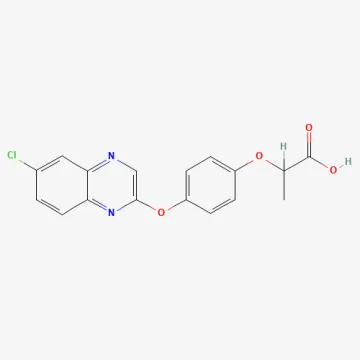
Quizalofop
Description
Mode of action
Quizalofop belongs to the chemical class of aryloxyphenoxypropionates, commonly known as "fops" or graminicides. These are systemic herbicides that are rapidly absorbed by weed foliage and translocated throughout the plant via the phloem to the points of active growth.
The primary mode of action is the inhibition of the enzyme acetyl-CoA carboxylase (ACCase). This enzyme is essential for fatty acid biosynthesis, which is necessary for the production of phospholipids used in building new plant cell membranes.
Inhibition of ACCase leads to a total cessation of cell division and eventual death of the meristematic tissues. Visible symptoms of damage, such as chlorosis and subsequent necrosis, appear in weed tissues within a few days after application.
Complete control of susceptible grass species usually takes 1 to 3 weeks, depending on environmental conditions and the growth stage of the weeds. Due to its systemic movement, quizalofop provides effective control not only of the foliage but also of the underground rhizomes of perennial grasses.
The high selectivity of quizalofop allows for its safe use in various broad-leaved crops. Non-grass species, such as soy or sunflowers, possess the ability to rapidly metabolize the active ingredient, ensuring they remain unharmed during the treatment.
What it targets
The quizalofop group (including quizalofop-P-ethyl and quizalofop-P-tefuryl) is designed to control a wide range of annual and perennial grass weeds. They are highly effective against problematic species like couch grass and various wild grasses.
- Couch grass (Elymus repens)
- Barnyard grass (Echinochloa crus-galli)
- Foxtail (Setaria spp.)
- Wild oats (Avena fatua)
- Bermuda grass (Cynodon dactylon)
These herbicides are extensively used in fields of sunflower, soybean, sugar beet, canola, flax, and other broad-leaved crops. They provide excellent control of both annual grasses and established perennial grasses that are otherwise difficult to eradicate.
A significant application for quizalofop is the management of volunteer cereals (like wheat or barley regrowth) in crops that are not herbicide-tolerant to standard cereal herbicides. It ensures clean fields throughout the crucial early stages of crop development.
The herbicide is strictly selective toward monocotyledonous (grass) plants. It shows no activity against broad-leaved weeds, which means a separate herbicide program is required to manage non-grass weed populations within the same field.
Rates and timing
The application rate of quizalofop varies depending on the weed species present and their growth stage. Typically, lower doses are effective against annual grasses, whereas higher rates are required for persistent perennial species like couch grass.
The optimal timing for annual grass control is the 2 to 4-leaf stage. For perennial weeds, it is critical to wait until the weeds have reached a height of 10–15 cm to ensure sufficient leaf surface area for maximum herbicide absorption.
Application should ideally occur during active weed growth under temperatures ranging from +15°C to +25°C. Stress factors such as prolonged drought, extreme heat, or cold can reduce the herbicide's effectiveness by affecting plant metabolic activity.
Avoid applying the herbicide if the grass weeds have reached the flowering stage or are over-mature. In such cases, the active ingredient's translocation is significantly inhibited, resulting in unsatisfactory weed control and potential regrowth.
The spray solution must be prepared according to specific instructions using high-quality water. A standard spray volume of 200–300 liters per hectare is typically sufficient to ensure uniform coverage of the target weed foliage.
Restrictions
When planning crop protection, be aware of mixing restrictions. Quizalofop is often incompatible with broad-spectrum broad-leaved herbicides due to the risk of antagonism, which can reduce the efficacy of both products in a tank mix.
It is recommended to maintain an interval of at least 5–7 days between applications of broad-leaved herbicides and quizalofop. This waiting period prevents chemical stress to the crop and ensures the best possible performance against grass weeds.
Although the active ingredient is quickly absorbed, applying it immediately before heavy rainfall should be avoided. If rainfall occurs 1–2 hours after application, the efficacy is usually maintained as the chemical has already penetrated the plant cuticle.
Quizalofop is highly effective against all grass species; therefore, extreme caution must be taken to prevent spray drift to adjacent cereal crop fields. Use specialized nozzles and avoid spraying during high wind conditions to protect neighboring fields.
Proper protective equipment (gloves, goggles, long-sleeved clothing) is mandatory for operators. Exposure to the concentrate can cause skin and eye irritation; follow all safety data sheet (SDS) guidelines during handling and storage.
Status in the European Union
Not approved in the EU
- CAS number
- 76578-12-6
- Category (EU)
- HB - Herbicide
EU status is for reference only and does not replace national registration in your country.