
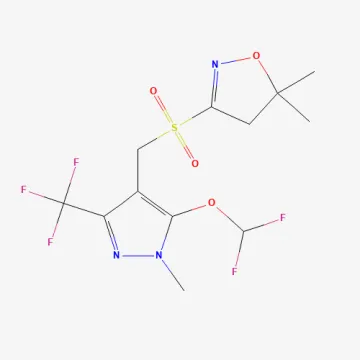
Pyroxasulfone
Description
Mode of action
Pyroxasulfone is a systemic herbicide belonging to the isoxazoline chemical class. It is widely recognized for its robust soil activity and long-lasting residual control of emerging weed populations.
The primary mechanism of action involves the inhibition of the Very Long Chain Fatty Acid (VLCFA) synthesis. By blocking this crucial process, the herbicide halts cell division in weed meristems, leading to the death of seedlings before they emerge.
The active ingredient is primarily absorbed by the roots and shoots of germinating weeds. It translocates efficiently through the xylem, providing a consistent protective zone in the upper soil profile.
Pyroxasulfone shows remarkable stability against photodegradation and leaching, ensuring that the protective herbicide layer remains effective even under varying rainfall conditions.
By effectively suppressing weeds during the critical early growth stages, this herbicide minimizes competition for water and nutrients, thereby supporting optimal crop establishment and yield potential.
What it targets
Pyroxasulfone provides excellent control over a broad spectrum of annual grasses and several key broadleaf weed species. It is particularly effective against weeds that have developed resistance to other common herbicide modes of action.
The target spectrum includes aggressive weed species that typically dominate agricultural fields during the spring planting season.
- Setaria species (foxtail)
- Echinochloa crus-galli (barnyardgrass)
- Digitaria species (crabgrass)
- Amaranthus species (pigweed)
- Chenopodium album (common lambsquarters)
The application of pyroxasulfone is vital for protecting high-value crops like maize, soybeans, and wheat from early-season weed interference.
Its systemic nature allows for the control of multiple germination flushes, reducing the need for post-emergence corrective treatments.
Rates and timing
Application timing is critical, with the best results obtained through pre-emergence or early post-emergence treatments. Proper timing ensures the product is in place before weed seeds begin to germinate.
Application rates must be adjusted based on soil type and organic matter content. Lighter, sandy soils generally require lower rates, while heavier or high-organic soils may need higher doses to maintain efficacy.
Adequate soil moisture is necessary to activate the herbicide layer and facilitate uptake by weed roots. Without sufficient moisture, the product may remain inactive on the soil surface.
When mixing with other pesticides, users must verify compatibility to prevent physical incompatibility or reduced herbicide performance.
Applying the product with a sufficient water volume is recommended to ensure uniform distribution across the soil surface, which is essential for consistent weed control performance.
Restrictions
A primary limitation is the sowing depth of the crop. Seeds must be covered with enough soil to prevent direct contact between the crop seedling and the herbicide, which could otherwise cause phytotoxicity.
Users should avoid application on soils with extreme characteristics (such as very low organic matter) unless specifically permitted by the product label to prevent crop injury.
Rotation planning is important as certain residues may persist in the soil depending on environmental conditions, potentially affecting sensitive follow-up crops in the next season.
Operators must wear appropriate Personal Protective Equipment (PPE), including gloves, goggles, and respiratory protection, to prevent accidental exposure to the concentrated substance.
To avoid off-target drift, application should only occur under favorable weather conditions, using appropriate nozzle technology to protect sensitive neighboring crops.
Status in the European Union
Not approved in the EU
- CAS number
- 447399-55-5
- Category (EU)
- HB - Herbicide
EU status is for reference only and does not replace national registration in your country.