
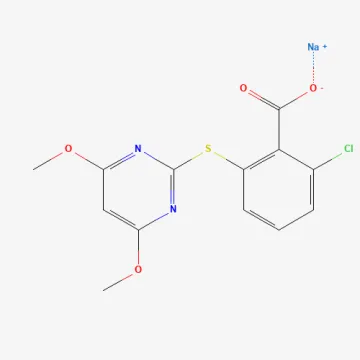
Pyrithiobac sodium
Description
Mode of action
Pyrithiobac sodium belongs to the pyrimidinylthiobenzoic acid chemical class. It is a systemic herbicide that acts selectively against a wide spectrum of broadleaf weeds.
The primary mode of action involves the inhibition of the acetolactate synthase (ALS) enzyme in susceptible plant species. Blocking this enzyme stops the biosynthesis of essential branched-chain amino acids, such as valine, leucine, and isoleucine.
The cessation of amino acid synthesis leads to a rapid stop of cell division in the meristematic tissues of the weed. As a result, weed growth stops almost immediately after the product is absorbed.
The active substance is absorbed by plants through both leaves and roots. This ensures high efficiency in controlling weeds during the critical early development stages of the crop.
Complete death of susceptible weeds typically occurs within 1–2 weeks after treatment. Initial signs of stress, such as chlorosis and necrosis at the growing points, appear within a few days.
What it targets
This active substance is primarily used for the protection of cotton crops against unwanted vegetation. It effectively suppresses a wide range of broadleaf weeds.
Target objects include persistent weeds such as Amaranthus species, common cocklebur, velvetleaf, and various knotweed species. The product shows high selectivity to cotton when applied according to guidelines.
The spectrum of action covers weeds in early growth stages, allowing the crop to avoid competition for moisture and nutrients at the start of the season.
Using this herbicide significantly reduces field weediness, which directly contributes to higher cotton fiber yields and improved harvest quality.
- Amaranthus species
- Common cocklebur (Xanthium strumarium)
- Velvetleaf (Abutilon theophrasti)
- Knotweed (Polygonum spp.)
Rates and timing
Application rates depend on the weed growth stage and the level of field infestation. Usually, the product is applied when cotton plants reach the first true leaf stage.
For maximum biological effectiveness, it is recommended to spray when target weeds are in the 2–4 leaf stage. At this period, weeds are most sensitive to the herbicide.
When using in tank mixes, consider the compatibility of all components. Pyrithiobac sodium requires good coverage of the leaf surface to ensure rapid absorption.
The temperature during application should be optimal, preferably between 15–25 degrees Celsius. Avoid applications during drought periods or when the crop is under stress.
The volume of the working solution must be sufficient for uniform wetting of the weeds. Use high-quality spraying equipment to ensure precise application.
Restrictions
It is not recommended to use pyrithiobac sodium on soils with very high pH levels, as this can affect the degradation rate of the active ingredient.
There are crop rotation restrictions to consider. Residues may be phytotoxic to sensitive crops like sugar beets or vegetables grown in subsequent seasons.
Avoid spray drift onto neighboring sensitive crop fields. Application near water bodies requires strict adherence to buffer zones.
Application on cotton varieties sensitive to ALS inhibitors may cause temporary yellowing or growth retardation. Always verify compatibility with specific cotton hybrids.
Repeated use of the same herbicide on the same field without rotating modes of action is discouraged to prevent the development of weed resistance.
Status in the European Union
Pending
- CAS number
- 123343-16-8
- Category (EU)
- HB - Herbicide
EU status is for reference only and does not replace national registration in your country.