
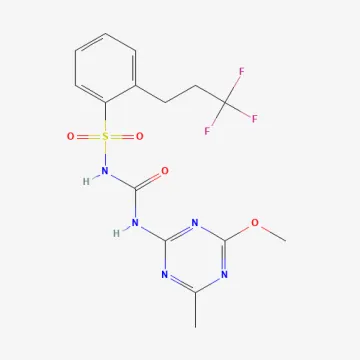
Prosulfuron
Description
Mode of action
Prosulfuron belongs to the chemical class of sulfonylureas. It is a systemic active ingredient that penetrates the plant primarily through the leaves and roots, moving rapidly through the vascular system.
The main mechanism of action is the inhibition of the acetolactate synthase (ALS) enzyme. Blocking this enzyme stops the synthesis of essential amino acids — valine, leucine, and isoleucine.
As a result of the disruption in amino acid biosynthesis, cell division stops, leading to a rapid cessation of weed growth within a few hours after application.
The first visual symptoms of injury, such as chlorosis and necrosis of growing points, appear within 3–7 days. Complete weed mortality occurs within 2–3 weeks.
The substance is characterized by high selectivity, which allows it to be used to protect crop plants without the risk of significant phytotoxic effects when regulations are followed.
What it targets
Prosulfuron is a highly effective herbicide for controlling many species of annual and some perennial broadleaf weeds in cereal and corn crops.
It is particularly effective against hard-to-kill species such as common lambsquarters, pigweed species, common ragweed, knotweed, black nightshade, and cleavers.
The herbicide shows high activity against weed species resistant to other herbicides, making it a valuable component of anti-resistance treatment programs.
The spectrum of action also includes certain species of cruciferous weeds that often infest early cereal crops during the spring season.
Due to its soil activity, prosulfuron is capable of suppressing subsequent emergences of susceptible weeds for a period after application.
Rates and timing
Application rates of prosulfuron depend on the weed species composition, field infestation density, and crop development stage, requiring strict adherence to instructions.
The optimal time for application is during the period of active weed growth — from the 2–4 leaf stage for annuals to the rosette stage for perennials.
On corn and cereal crops, application should be carried out at stages recommended for specific products based on this substance, avoiding periods of plant stress.
The spray solution must uniformly cover the leaf surface of the weeds to ensure maximum absorption of the active ingredient.
When used in tank mixtures, it is necessary to conduct a compatibility test to prevent precipitation or a reduction in efficacy.
Restrictions
There are strict crop rotation restrictions: due to the risk of residual activity on sensitive crops (e.g., sugar beets or oilseed rape), specific waiting intervals must be observed.
It is not recommended to apply prosulfuron to crops that are under stress due to drought, excess moisture, low temperatures, or pest infestation.
It is important to avoid spray drift to neighboring fields with sensitive crops, as the substance exhibits high biological activity even at low doses.
When handling the product, personal protective equipment for the respiratory tract, skin, and eyes must be used, following general pesticide safety rules.
Do not allow the product or its residues to enter water bodies or drinking water sources, as it may have a negative impact on aquatic organisms.
Status in the European Union
Approved in the EU
- CAS number
- 94125-34-5
- Category (EU)
- HB - Herbicide
- Approved from
- 01.05.2017
- Approval until
- 15.06.2026
- ADI
- 0.02 mg/kg bw/day
- ARfD
- 0.1 mg/kg bw
- AOEL
- 0.06 mg/kg bw/day
EU status is for reference only and does not replace national registration in your country.