
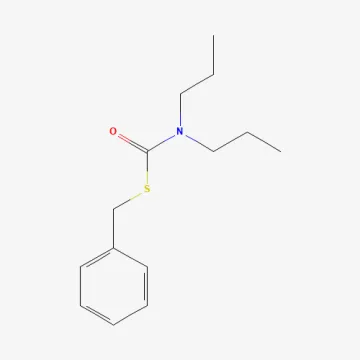
Prosulfocarb
Description
Mode of action
Prosulfocarb belongs to the chemical class of thiocarbamates. It is a systemic soil-applied herbicide that acts primarily through absorption by seedlings and roots of weeds during their germination process.
The mechanism of action involves inhibiting lipid biosynthesis and cell division in the meristem. Consequently, weed growth is halted at early stages, leading to the death of the seedling before or shortly after emergence from the soil surface.
The substance exhibits high selectivity for major agricultural crops. Due to its ability to enter the plant through roots and shoots, it creates an effective barrier against early flushes of weeds.
The product is characterized by moderate mobility in the soil profile. Its activity is directly dependent on soil moisture levels, as quality distribution of active ingredients in the top layer is required to form a protective film.
For maximum biological efficacy, it is essential that the soil is well-prepared, finely crumbled, and free of large crop residues that might obstruct the contact of the herbicide with weed seeds.
What it targets
Prosulfocarb demonstrates high efficacy against a broad spectrum of annual grasses and certain broad-leaved weeds. It holds significant importance in resistance management programs for controlling species resistant to other herbicide classes.
The product effectively suppresses dangerous weeds such as black-grass, foxtail, annual meadow grass, as well as some species of amaranth and lambsquarters. This makes it an essential component of anti-resistance strategies.
Application of the product significantly reduces competitive pressure on young crops during critical development periods. Prosulfocarb is indispensable for combating weeds that germinate from the upper soil layer.
The target range includes both seed-propagating species and many early spring grasses. The product's action also extends to some smartweed species, which increases its value for agronomists.
It is important to note that against perennial weeds with developed root systems, this herbicide shows only a suppressive effect and is not capable of ensuring their complete eradication.
Rates and timing
The application of prosulfocarb is generally timed for the pre-emergence period or early stages of crop development. The dosage varies depending on soil type, weed pressure, and the specific weed composition.
In cereal crops, optimal application is considered to be immediately after sowing but before crop emergence. This allows for the creation of a protective barrier that suppresses weed growth for several weeks.
When used on potatoes, application is often carried out after planting but before the crop emerges. This minimizes the risk of phytotoxicity and ensures field cleanliness at the beginning of the growing season.
Recommended dosage rates depend on soil humus content: on heavy soils with high organic matter, the use of maximum permitted rates as prescribed in the label is required.
The product can be tank-mixed with other herbicides to broaden the spectrum of action; however, always conduct a physical and chemical compatibility test before mixing.
Restrictions
The main limitation when working with prosulfocarb is the need for sufficient soil moisture. Under arid conditions, the effectiveness of the herbicide barrier may be significantly reduced.
It is crucial to strictly adhere to recommended seed planting depths. Too shallow planting increases the risk of the product reaching the seedling zone, which can lead to temporary growth inhibition or damage.
The product is not recommended for use on soils with very low organic matter and high sand content, as this increases the risk of leaching the active ingredient into the root zone.
Regarding crop rotation, prosulfocarb does not impose strict limitations, but when planning sensitive crops for the following year, dosage rates from the previous season should be considered.
When handling the product, standard personal protective equipment must be used. Avoid spray drift onto neighboring fields with sensitive crops by following safety guidelines during windy conditions.
Status in the European Union
Approved in the EU
- CAS number
- 52888-80-9
- Category (EU)
- HB - Herbicide
- Approved from
- 01.11.2009
- Approval until
- 31.01.2027
- ADI
- 0.005 mg/kg bw/day
- ARfD
- 0.1 mg/kg bw
- AOEL
- 0.007 mg/kg bw/day
EU status is for reference only and does not replace national registration in your country.