
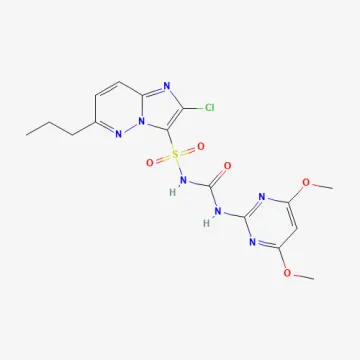
Propyrisulfuron
Description
Mode of action
Propyrisulfuron is a member of the sulfonylurea chemical class. It acts as a systemic herbicide by inhibiting the acetolactate synthase (ALS) enzyme.
This inhibition prevents the biosynthesis of essential amino acids such as valine, leucine, and isoleucine, which are critical for cell division.
The substance is absorbed by both foliage and roots, effectively translocating through the xylem and phloem to reach the meristematic tissues.
Plants stop growing shortly after application, with chlorosis and necrosis appearing in the following days as the herbicide disrupts internal physiological processes.
The high selectivity of this compound ensures effective weed eradication while maintaining the physiological health of the primary crop.
What it targets
Propyrisulfuron is primarily used to control a broad spectrum of broad-leaved weeds in various agricultural settings.
The herbicide is highly effective against several problematic weed species, including:
- Amaranthus retroflexus
- Chenopodium album
- Polygonum species
- Capsella bursa-pastoris
- Cirsium arvense
Its primary applications are found in cereal crop and rice fields, where it provides robust control against competing weed flora.
The herbicide is capable of suppressing even overgrown weeds, providing agronomists with a reliable solution for delayed weed control management.
Rates and timing
Application rates for propyrisulfuron are tailored based on the weed species composition, their growth stage, and prevailing environmental conditions.
Optimal efficacy is observed when the herbicide is applied during the early growth phase of weeds, typically between the 2 and 4-leaf stage.
The working solution should be prepared according to specific manufacturer instructions to ensure an even distribution of the active ingredient.
Applications are recommended during early morning or late evening hours, avoiding extreme heat to maintain the stability of the active compound.
It is advised not to spray if heavy rainfall is expected shortly after application, as this can lead to run-off and reduced biological impact on weeds.
Restrictions
Careful consideration of crop rotation is necessary, as residual effects of sulfonylureas may influence the growth of subsequent sensitive crops.
Application should be avoided on crops under significant stress, such as drought, extreme cold, or those infested with heavy pest populations.
When mixing with other pesticides, users must perform a compatibility test to avoid chemical instability or decreased effectiveness in the spray tank.
Operators must adhere to strict safety protocols, including wearing protective clothing, goggles, and respirators during the handling and spraying process.
Precautions should be taken to prevent drift, especially when neighboring fields contain crops susceptible to sulfonylurea damage.
Status in the European Union
Not approved in the EU
- CAS number
- 570415-88-2
- Category (EU)
- HB - Herbicide
EU status is for reference only and does not replace national registration in your country.