
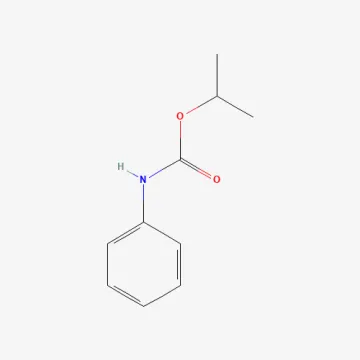
Propham
Description
Mode of action
Propham (isopropyl-N-phenylcarbamate) belongs to the chemical class of phenylcarbamic acid derivatives. It is a systemic herbicide that primarily acts on plants through the root system and sprouts, inhibiting cell division processes.
The mechanism of action is based on blocking mitosis in the meristematic tissues of sensitive plants. The substance disrupts the formation of the spindle apparatus, which halts the growth of weed roots and sprouts shortly after contact with the active ingredient.
Propham's action is characterized by high selectivity for a range of crop plants. In the soil, the substance undergoes relatively rapid microbial degradation, which eliminates long-term residual effects on subsequent crops in the rotation.
An important aspect is that the efficacy of the product directly depends on soil moisture and temperature. In drought conditions, the absorption of the active ingredient by the root system slows down, reducing the herbicidal effect.
In modern agronomy, products of this group are most often used in tank mixtures to enhance the action of other herbicides, broadening the spectrum of controlled weeds and preventing the emergence of resistance.
What it targets
Propham is effective in controlling a wide range of annual grass weeds in their early stages of development. Species that germinate from seeds in the topsoil layer are the most sensitive to the active ingredient.
The primary targets for the application of this product include weed species such as wild oats, various foxtail species, and millet-like grasses. In some cases, suppressive effects are observed on certain species of broadleaf weeds.
The application of the product is most appropriate in crops of vegetables and certain field crops that show resistance to carbamic acid derivatives, allowing for selective weeding.
The main purpose of using herbicides of this group is to suppress the first "wave" of weeds, allowing crops to pass through critical early growth stages without competition for nutrients and moisture.
The use of propham requires precise timing of application, as this herbicide shows low efficacy against overdeveloped weeds with established root systems.
Rates and timing
Application rates for the product vary depending on soil texture and weed composition. In heavy soils with high humus content, higher dosages are usually required to reach the necessary concentration of the substance in the soil solution.
Application timing is scheduled for pre-sowing cultivation or treatment immediately after sowing, but before the emergence of crop seedlings. This creates a "protective screen" in the topsoil, which destroys weed sprouts as they attempt to emerge.
When used in tank mixtures, propham dosages can be adjusted downward. This helps reduce the total pesticide load on the soil while maintaining high efficiency in controlling weed infestations.
The temperature regime during application plays a decisive role. Optimal conditions are in the range of 10 to 20 degrees Celsius, as high temperatures accelerate evaporation and the degradation of the product in the soil.
When planning agrotechnical operations, it is necessary to consider that the product does not have foliar action, so application post-emergence on crops is extremely limited or excluded.
Restrictions
Working with carbamic acid derivatives requires strict adherence to safety protocols. Personnel must use personal protective equipment for the respiratory tract, skin, and mucous membranes to prevent contact with the concentrate.
There are restrictions on use in light, sandy soils, where rapid migration of the active ingredient to deeper horizons is possible, increasing the risk of damage to the crop's root system.
Application is prohibited near bodies of water and drinking water sources due to the danger of leaching. Strict control is required to prevent spray drift onto neighboring agricultural land.
- Mandatory use of functional spraying equipment with precise calibration.
- Adherence to regulations regarding pre-harvest waiting periods.
- Storage of products in dry, ventilated warehouses away from animal feed.
- Disposal of empty containers in accordance with environmental regulations.
Before application, always read the current label of the specific product, as the presence of auxiliary components in the formulation may significantly change the requirements for application regulations.
Status in the European Union
Not approved in the EU
- CAS number
- 122-42-9
- Category (EU)
- HB - Herbicide
EU status is for reference only and does not replace national registration in your country.