
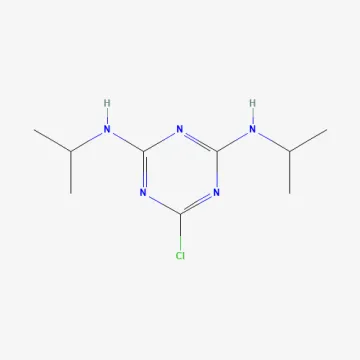
Propazine
Description
Mode of action
Propazine belongs to the chemical class of symmetric triazines. It is a systemic herbicide that penetrates the plant primarily through the root system, moving through the xylem with the water flow to the above-ground organs.
The main mechanism of action is the blockage of the photosynthesis process in weeds. The substance inhibits the Hill reaction, preventing electron transport in the light phase of photosynthesis.
As a result of metabolic disruption, sensitive plants cease carbon dioxide fixation and energy production, leading to chlorosis, yellowing, and the subsequent death of weeds.
The effectiveness of the product directly depends on the presence of soil moisture, as the active substance is actively absorbed by weed root hairs only when moisture is available.
The application of the product is most effective at the early stages of weed development, when they are in the seedling or sprout phase.
What it targets
Propazine is a selective herbicide used to control a wide range of annual broadleaf weeds and some grass weeds.
The product effectively suppresses species such as amaranth, lambsquarters, knotweed, hemp-nettle, and other species commonly found in agricultural crops.
An important advantage is the long-lasting residual effect, which prevents the emergence of new weed flushes throughout the growing season of the crop.
Due to its high selectivity, when applied according to the guidelines, cultivated plants can metabolize the active substance, neutralizing it into harmless compounds.
The degree of weed control depends on their species composition and developmental stage at the time of treatment, making accurate identification essential.
Rates and timing
Application rates of the product vary depending on soil type: higher doses are required on heavy clay soils with high humus content.
On light, sandy soils, minimum application rates should be used to avoid leaching the herbicide into the crop's root zone.
Soil treatment is usually performed pre-emergence of the crop or simultaneously with sowing, ensuring uniform distribution of the solution over the field surface.
A mandatory condition is the availability of sufficient moisture in the soil, which may require irrigation under arid conditions to activate the product.
When planning agricultural operations, crop rotation must be taken into account, as triazine residues can persist in the soil and affect sensitive crops in the following season.
Restrictions
Application during windy conditions is prohibited to prevent spray drift onto neighboring sensitive crop fields.
Strict adherence to safety protocols when handling pesticides is required, including the use of personal protective equipment for the skin, eyes, and respiratory system.
In case of contact with skin or mucous membranes, immediate washing with plenty of running water and medical consultation are required.
Special attention must be paid to the protection of water bodies: discharging product residues into open water sources or sewage systems is prohibited.
Empty containers must be disposed of in accordance with environmental regulations; they must never be reused for household purposes.
Status in the European Union
Not approved in the EU
- CAS number
- 139-40-2
- Category (EU)
- HB - Herbicide
EU status is for reference only and does not replace national registration in your country.