
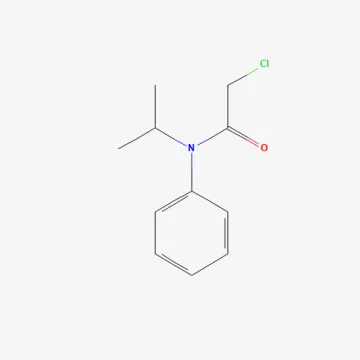
Propachlor
Description
Mode of action
Propachlor is a selective herbicide belonging to the chloroacetamide chemical class, specifically designed to control annual weeds at their earliest growth stages.
The mechanism of action involves the inhibition of cell division and protein synthesis within the meristematic tissues of germinating weed seeds, leading to their death before emergence.
It is primarily absorbed by the roots and the coleoptile of germinating seeds. Optimal efficacy is achieved when applied either pre-sowing or pre-emergence, depending on the crop and regional practice.
The substance creates an active "protective barrier" in the upper soil layer. Adequate soil moisture is essential for the activation and uniform distribution of the herbicide in the target zone.
Compared to other chloroacetamides, propachlor demonstrates lower soil persistence, which offers more flexibility regarding crop rotation and reduces long-term environmental impact.
What it targets
This substance is highly effective at suppressing a wide range of annual grass weeds and some broadleaf species within various agricultural crops.
Key target species include barnyard grass, annual bluegrass, and certain species of pigweed, which often compete with seedlings for nutrients and water.
Propachlor does not provide significant control over established perennial weeds with deep root systems or weeds that have already reached advanced growth stages.
Application is most critical during the early vegetation phase to ensure that the crop establishes itself without the stress of weed competition.
- Barnyard grass (Echinochloa crus-galli)
- Annual bluegrass (Poa annua)
- Pigweed species (Amaranthus spp.)
Rates and timing
Application rates for propachlor must be adjusted based on soil texture and organic matter content. Soils with higher clay content typically require higher dosages.
The application window is usually pre-planting or immediately post-planting. It is crucial to have sufficient soil moisture at the time of application to ensure the chemical activates properly.
Tank mixtures are often employed to broaden the spectrum of weed control, though compatibility tests should always be performed prior to mixing in the sprayer tank.
Uniform coverage of the soil surface is necessary to maintain an effective barrier. Poor application techniques may lead to uneven weed control across the field.
Strict adherence to label instructions regarding timing and crop growth stage is mandatory to avoid phytotoxicity and maximize the protection of the crop stand.
Restrictions
There is a potential risk of phytotoxicity if heavy rainfall occurs shortly after application, which could leach the herbicide into the crop's root zone.
Usage on soils with very low organic matter content is generally discouraged to prevent potential damage to the developing root system of the crop.
Operators must take measures to prevent drift, especially in areas adjacent to sensitive crops or ecological zones, following all safety protocols for pesticide handling.
Storage should be in cool, well-ventilated areas, away from direct sunlight and moisture, to ensure the chemical stability of the herbicide over time.
Agronomists should document applications and monitor field conditions to comply with regional safety standards and residue management practices.
Status in the European Union
Not approved in the EU
- CAS number
- 1918-16-7
- Category (EU)
- HB - Herbicide
EU status is for reference only and does not replace national registration in your country.