
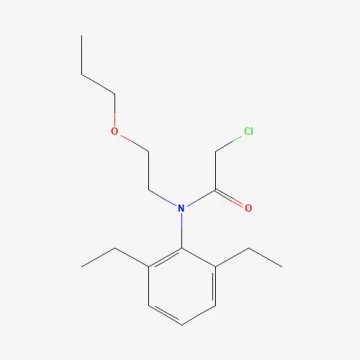
Pretilachlor
Description
Mode of action
Pretilachlor belongs to the chloroacetanilide chemical class. It is a highly effective active ingredient that exhibits systemic activity in controlling unwanted vegetation.
The mechanism of action is based on the inhibition of cell division and protein synthesis in weeds. The compound disrupts metabolic processes, preventing the normal development of meristematic tissues.
Upon entering the plant, the substance blocks root and shoot growth at the early stages of development. As a result, weeds die before or immediately after emergence, unable to compete with the crop.
A key feature of pretilachlor is its high selectivity for the main crop, rice. To ensure crop safety, the product is often applied in combination with safeners such as fenclorim.
The active ingredient provides a prolonged soil effect, creating a protective layer that suppresses the germination of new weed flushes for several weeks post-application.
What it targets
Pretilachlor is primarily used for controlling annual grasses, broad-leaved weeds, and some sedges characteristic of paddy fields.
Key weed species sensitive to the substance include:
- Echinochloa crus-galli (barnyard grass);
- Cyperus species;
- Monochoria vaginalis;
- various Pondweed species.
The use of this product allows for effective cleaning of rice crops from weed species that typically dominate in waterlogged and flooded field conditions.
The action is directed at suppressing seedlings, so the highest efficacy is observed when applied before weed emergence or at the 'spike' stage.
Due to its high concentration, the herbicide provides reliable control of dense weed populations, preventing their negative impact on rice yields.
Rates and timing
Application rates of pretilachlor depend on soil type, weed density, and the formulation, typically ranging from 0.5 to 1.0 kg of active ingredient per hectare.
Application is carried out mainly by spraying the soil surface or by introducing it into the irrigation water when flooding the paddies.
Optimal timing is during the soil preparation stage before sowing or immediately after sowing, prior to weed germination.
It is important to distribute the product evenly across the area to form a stable herbicidal film, which is critical for achieving the expected result.
It is recommended to monitor water levels in the paddies, as the efficacy of the product directly depends on its concentration in the water environment.
Restrictions
The use of pretilachlor requires strict adherence to temperature and humidity conditions, as efficacy decreases with excessive evaporation or failure to maintain water levels.
Application is prohibited on soils with extremely high organic matter or sand content, as this may lead to inconsistent efficacy or phytotoxicity.
Handling the substance requires the use of personal protective equipment, as the product may cause skin and mucosal irritation upon direct contact.
Drift to neighboring crops sensitive to chloroacetanilide herbicides must be prevented during aerial or ground applications.
Residues and containers must be disposed of according to environmental regulations, preventing contamination of open water bodies and drinking water sources.
Status in the European Union
Not approved in the EU
- CAS number
- 51218-49-6
- Category (EU)
- HB - Herbicide
EU status is for reference only and does not replace national registration in your country.